


An outdoor business sign is on duty all the time, in every kind of weather, whether or not anyone is looking. So the material, construction, and lighting you pick end up shaping how it looks in year three, not just on install day. This guide runs through the questions buyers ask most often about weather, durability, and visibility, so you can spec a sign with fewer surprises down the road.
Key takeaways
- Weather sets the spec. Sun, rain, wind, temperature swings, and snow each work on a sign in their own way, so material and construction should suit your local climate.
- The material choice is a set of tradeoffs. Aluminum, stainless steel, acrylic, and high-density urethane each balance weather resistance, weight, look, and cost differently.
- Visibility is really a design problem: size, font, color contrast, and placement, in daylight and after dark.
- Lighting keeps a sign legible at night. Front-lit, halo-lit, and lightbox options all do this in different ways.
- Where and how a sign is mounted changes how much weather it takes on.
- A little upkeep, mostly cleaning and the occasional look-over, catches small problems while they are still small.
- A visual mockup, like one built in Signage.com's Design Studio, helps you judge scale and look before anything gets made.
How does weather affect an outdoor sign?
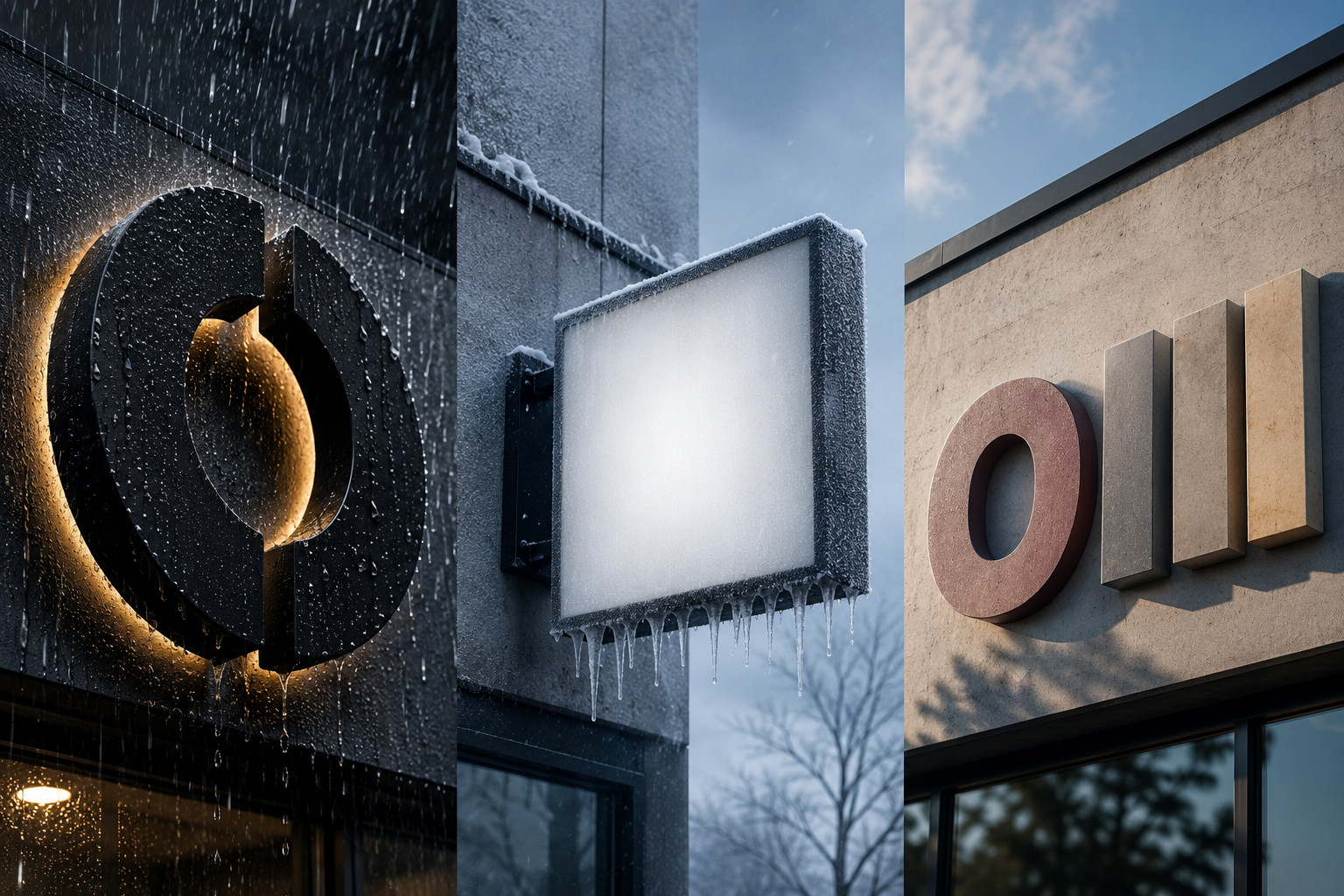
Weather is the biggest single factor in how a sign ages. Sun, moisture, wind, and temperature all add up over time, which is why it pays to settle material and construction early rather than leave them to the end.
| Weather factor | What it does to a sign | What tends to help |
|---|---|---|
| UV / sunlight | Fades color and can make some plastics brittle over time | UV-stable acrylic, quality finishes, fade-resistant pigments |
| Rain and moisture | Corrodes untreated metal, warps some materials, stresses electrical connections | Non-corrosive metals, sealed enclosures for electronics |
| Wind | Loads the mounting points and can flex or loosen a sign | Right gauge material and solid anchoring for the spot |
| Temperature swings | Expansion and contraction can crack or peel a surface | Materials and adhesives rated for outdoor temperature ranges |
| Snow and ice | Adds weight, can hide the face, and can widen cracks that already exist | Smooth surfaces that shed buildup, sensible drainage |
Because these forces vary so much from one region to the next, it helps to think about your own climate when you compare options. OSHA's weather guidance is a reminder of how hard outdoor conditions can be over time, and of why a sign meant to live outside needs materials chosen for that exposure. If you want a starting point, our outdoor signs collection is built with that in mind.
Which materials hold up outside?
There is no single right material for every outdoor sign. Aluminum, stainless steel, high-grade acrylic, and high-density urethane all bring something different, so the pick usually comes down to weighing weather resistance, weight, look, and cost against what you actually need.
Aluminum. Light, resists rust and corrosion, and takes paint and fabrication well. You see it in channel letters, dimensional letters, and lightbox signs. It can dent or bend under a hard hit if it is not reinforced. A common choice for general outdoor use, including places where corrosion is a worry.
Stainless steel. Strong, resists rust and wear, and has a clean, high-end look. It is heavier and usually costs more than aluminum, and it is more work to fabricate. Often used for corporate and professional-office signage where the refined look matters.
Acrylic (plexiglass). Good weather resistance, UV-stable formulations that resist yellowing, a wide color range, and it lights up nicely. Used for dimensional letters, lightbox faces, and engraved signs. It scratches more easily than metal. A go-to for illuminated signs and designs that want bright color or a modern feel.
High-density urethane (HDU). Waterproof, does not rot, and insects leave it alone, and it can be carved to look like wood. It is less impact-resistant than metal. Common for monument and pylon signs, and for carved or routed designs with a traditional or textured feel.
When you compare these, think about how each one will look after a few years outside, not only how it looks new. Spending a little more on durable material up front can save you a fading or cracking problem, and an earlier replacement, later.
How can a sign stay visible day and night?
Visibility comes from getting size, placement, contrast, and lighting to work together. For a lot of people driving or walking past, the sign is the first thing they read about your business, so it needs to be legible from the distances and angles that matter where you are.
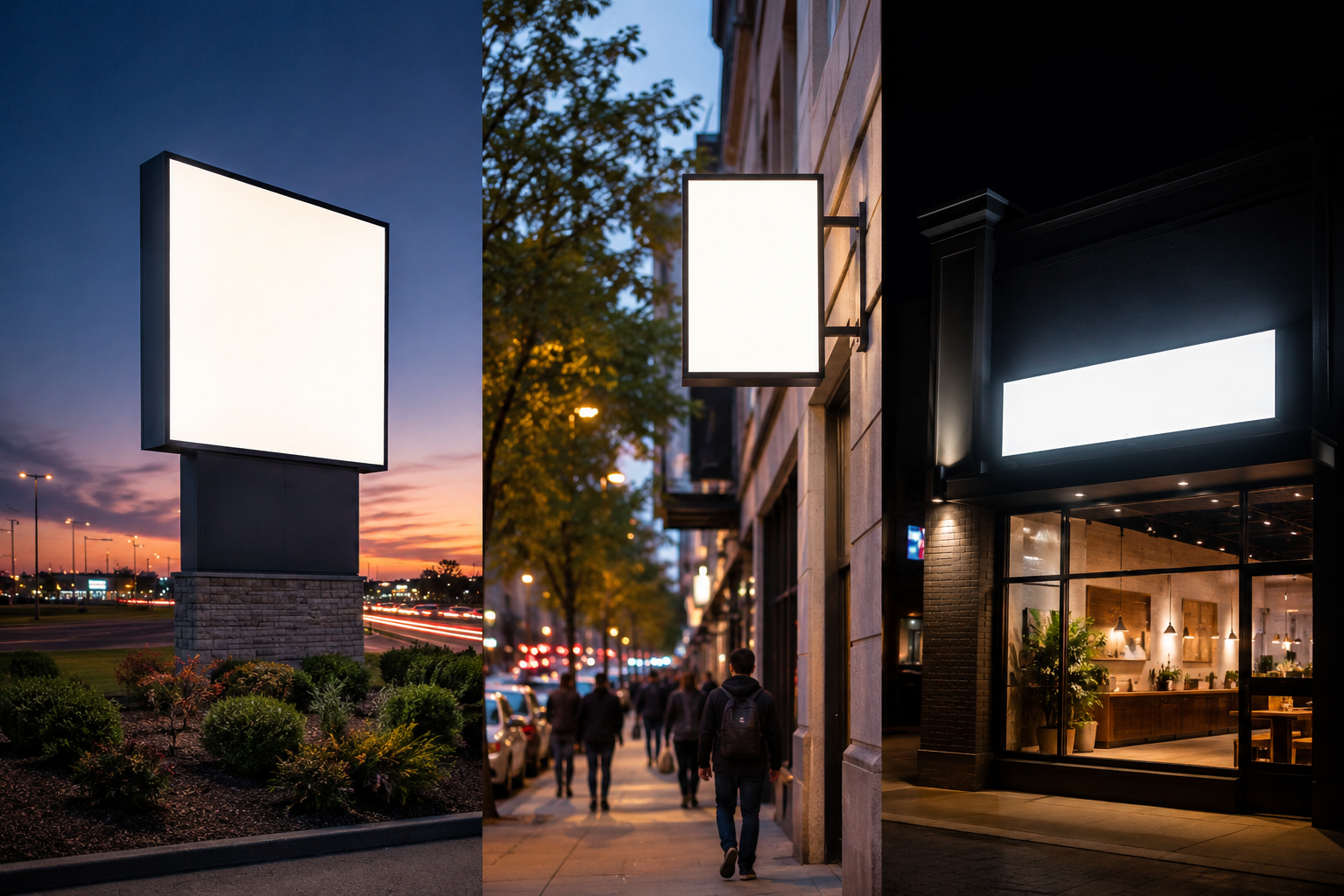
Placement matters first. Keep the sign in view for both drivers and people on foot, with no trees, poles, or other signs in the way, and put it where people have time to notice and react. That might mean a taller pylon sign for road traffic or a perpendicular blade sign for foot traffic.
Size follows the viewing distance. Copy that reads fine up close can vanish from a moving car, so scale to the distance you care about. And read the sign against its building. A small sign on a big facade tends to get lost.
For legibility, lean on clear, simple fonts and strong contrast. Very thin or ornate typefaces are harder to parse at a distance. Dark on light, or light on dark, usually reads best across changing light.
Lighting is what keeps a sign working after dark, when an unlit storefront can basically disappear. A few common approaches:
- Front-lit channel letters push light through the letter faces for bright, direct illumination. A common pick for retail and restaurant storefronts.
- Halo-lit (backlit) channel letters glow from behind for a softer effect, often chosen for a more understated look.
- Lightbox (LED cabinet) signs put a translucent face over a lit box, which spreads light evenly across logos and detailed graphics.
- External lighting, like floodlights, can light non-illuminated dimensional letters or monument signs.
- Timers or photo-sensors let the sign come on when it is actually needed.
You can look at lit options in our channel letter signs collection.
What to ask a sign company before you order
A few focused questions up front make it easier to compare providers and land on a sign that fits your climate, location, and brand. A good sign company will talk you through the tradeoffs instead of jumping straight to a quote.
On material and durability, ask which materials they would suggest for your climate and why, and how those materials handle fading, corrosion, and impact.
On visibility and lighting, ask what size and placement they would suggest for your street and sidewalk, and which lighting options fit your brand and location, including how they read in daylight versus at night.
On design, ask how you will see a visual preview before anything is made (for example a mockup built in Signage.com's Design Studio), and what files they need from you, like a logo or brand colors, to build an accurate design.
On mounting and site, ask what mounting methods are typical for the sign type you are considering, and what details about your building would help them plan.
On permitting, ask whether they can provide product specs you can share with your permit process. Keep in mind that permit rules vary by locality and are generally handled by the business owner or a local installer. Signage.com can supply specs but does not manage local permitting or installation.
On cost and lead time, ask what tends to move the final price and schedule, and whether there are extra costs to plan for, like shipping or specialty finishes.
None of this locks in a price or a timeline. The point is to surface the variables early so the quote you get back reflects your actual project.
Common outdoor sign mistakes
Most of the things that trip up an outdoor sign are avoidable with a bit of planning around design, materials, and placement.
- Underestimating weather. Materials that are not rated for outdoor use fade, crack, or fail sooner, and a beat-up sign says the wrong thing about the business behind it.
- Weak legibility. Small type, busy fonts, or low contrast make a sign hard to read at a distance or in shifting light.
- Ignoring nighttime. Skip lighting and the sign stops working after dark, during hours that can still be worth something.
- Wrong size or placement. Too small for the facade, mounted too high or low, or blocked by landscaping or utilities, and it gets overlooked.
- Cluttered design. Cramming too much onto one sign works against clarity. Lead with the essentials.
- Overlooking local rules. Zoning and permit requirements differ by area, and checking them early saves rework.
- Letting maintenance slide. Faded, dirty, or damaged signs read as neglect. A little regular care goes a long way.
- Skipping a preview. Signing off from flat artwork alone can lead to scale surprises. A mockup on your actual building, like one from Signage.com's Design Studio, takes some of that guesswork out.
How the Design Studio helps with outdoor sign decisions
Signage.com's Design Studio is a visual mockup tool. It lets you preview sign concepts on your own building before you commit to production. It is there to cut down guesswork in what is really a visual buying decision. It is not final engineering, permit, fabrication, or code-compliance documentation.
A few ways people use it:
- Upload a photo of your storefront to see how different sign types, sizes, and placements might sit on your facade.
- Switch between channel letters, dimensional letters, or lightbox signs and try different finishes to see what fits your brand.
- Get a visual sense of how front-lit, halo-lit, or internally lit signs read at night.
- Test scale and mounting spots to gauge how big the sign may need to be.
- Come to the quote conversation with a clear visual direction and your logo files, which helps the sign team understand what you are after.
For a lot of owners and managers, going from a description to an actual picture answers the two questions that come up first: will it look right, and is it the right size.
Where to start
Picking an outdoor sign means weighing weather, durability, and visibility side by side, then matching materials, lighting, and placement to your location and brand. Choosing durable materials up front, planning for both day and night, and previewing the design before production are what keep you clear of the more expensive mistakes. Pair a visual preview with a few good questions to your provider and you are in a solid spot. To start looking at options, browse our outdoor signs collection.
FAQ
How often should an outdoor sign be maintained? A yearly cleaning and look-over is a reasonable starting point, and it helps you catch small issues before they grow. The right cadence depends on your climate and sign type.
Can outdoor signs handle severe weather like hurricanes or blizzards? No sign is indestructible, but ones built with durable materials and solid mounting are made to take demanding conditions. Talk with a sign company about designs suited to your local climate.
What is the difference between front-lit and halo-lit channel letters? Front-lit letters light up through the face for direct brightness. Halo-lit (backlit) letters glow from behind onto the mounting surface for a softer effect.
Do I need a permit for my outdoor sign? Many localities require them, and the rules on size, placement, and lighting vary by city and county. Signage.com can provide product specs, but getting the permit is generally the business owner's or a local installer's responsibility.
How can I keep a sign visible at night without it being too bright? Options like dimmable LEDs or halo lighting, chosen with the surrounding area in mind, can balance visibility against a comfortable brightness. A sign company can advise on lighting type and intensity.
Are there more energy-efficient options for outdoor signs? Many outdoor signs use LED lighting, which typically draws less power than older neon. You can also ask your provider about materials and finishes that fit sustainability goals.
