


When you buy signs for a business, one early choice shapes a lot of what comes after: a national signage company or a local sign shop. They tend to fit different situations. A national provider is usually built for repeatable processes and multi-site coordination. A local shop often runs on close, hands-on service and familiarity with its own area. Which one fits depends on how big the job is, how much consistency you need across locations, and how you like to communicate.
Below is a plain comparison of the parts that actually differ: scope, communication, how quotes are structured, design and materials, and who handles permitting and installation. Use it to measure providers against your own project instead of a generic checklist.
The short version
- A national signage company is generally organized around multi-location rollouts, larger production runs, and coordinated project management.
- A local sign shop usually offers direct, personal service and closer knowledge of its immediate area.
- Scope tends to decide it. National often suits uniformity across many sites; local often suits a single, distinctive storefront.
- Communication differs: owner-level contact at a local shop versus more structured, tiered support at many national firms.
- Cost structures differ too. National providers may price for volume; local shops may be flexible on smaller, specialized jobs. Ask for an itemized quote either way.
- Materials and design approaches vary, so request samples and a visual mockup before you commit.
- Sort out permitting and installation responsibilities early. They are handled differently from one provider to the next.
What each one usually means
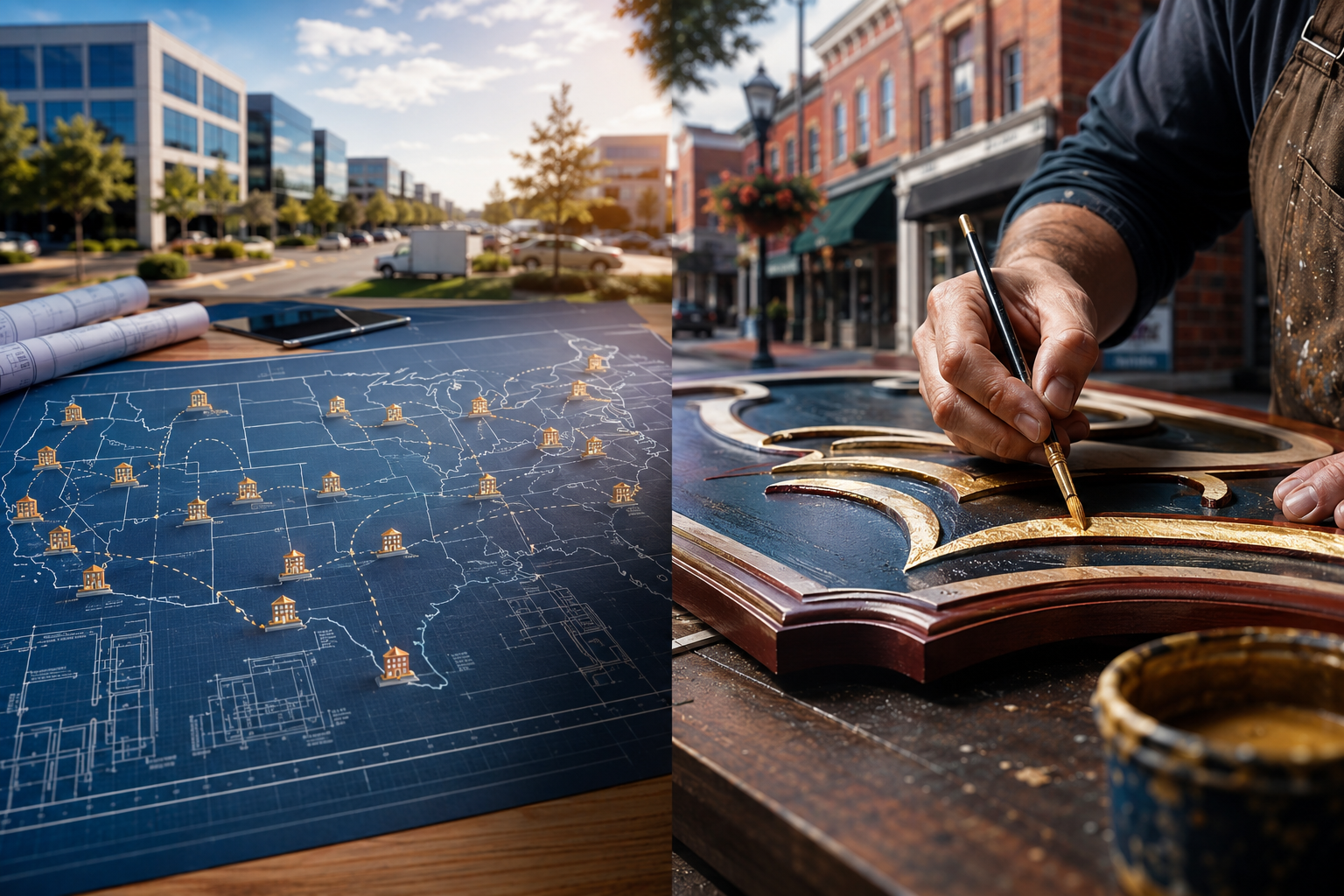
A national signage company generally works across many states or nationwide. It handles larger production volumes, multi-site logistics, and sign programs for franchises or corporations. A local sign shop usually serves a defined area and focuses on individual businesses nearby, with a more hands-on approach. Neither is better on its own. They are set up for different kinds of work.
National firms tend to share a few traits. They are built for higher-volume orders and multi-location rollouts, including larger projects like pylon or monument signs that involve more engineering and logistics. They lean on standardization to keep branding and specs consistent across many locations, which matters for chains and franchises. They often assign a project manager to coordinate design, fabrication, shipping, and installation across sites, and they may have broader material sourcing and production capacity for large programs. Managing an organization's full signage portfolio is a common specialty.
Local shops usually look different. You often deal directly with the owner or a small team, which can make it easier to explain what you want. Many know area permitting norms, zoning, and local aesthetics well. They tend to be responsive on smaller custom projects or repairs because there are fewer internal layers, and they are frequently part of the local business community. For a distinctive, detail-heavy storefront or indoor sign, that hands-on approach can be a good fit.
The core difference is scope and approach. National providers lean toward consistency across a wide footprint. Local shops lean toward tailored service in their own area.
How scope shapes the choice
Scope is usually the most useful thing to look at first. A business rolling out signage across many sites tends to benefit from a national provider's coordination. A single-location shop that wants a distinctive storefront sign is often better served locally. Matching a provider's strengths to the actual job saves friction later.
A national company tends to fit when you run several locations and want branding, materials, and specs aligned across them. It also fits larger, more complex builds, such as illuminated channel letters on a tall facade, monument signs, or highway-visible pylon signs, where more engineering and fabrication bandwidth helps. Ongoing sign programs across a franchise system, from design through maintenance, are a common national offering, and broader material and process sourcing is more common at larger firms.
A local shop tends to fit a standalone storefront, medical office, or service business, where close attention to your site and look matters. It suits handcrafted or highly customized signs, and it is often quicker on a modest indoor-sign order or a repair without larger-organization overhead. Local shops frequently know their city or county's process well, which can help move approvals along, and on smaller or less complex projects their pricing can be competitive.
A common misstep is misjudging scope in either direction. A single storefront request can get deprioritized in a very large pipeline, and a national rollout can stretch a small shop's capacity. Be specific about your project's reach and how much standardization you need. It makes every quote more accurate.
What communication and support to expect
Support structures differ enough that it is worth asking directly. National providers often work through a dedicated project manager and formal steps. Local shops tend toward more direct, informal contact. Neither is automatically better; the question is whether the style matches how you like to work.
With a national company, you will often work with one project manager coordinating design through installation, which is efficient but sometimes less personal. Communication tends to follow set steps, with scheduled updates, documentation, and sometimes separate teams for design, production, and installation. Expect online portals and shared files. Visual tools like the Signage.com Design Studio can help you preview sign concepts and compare options such as letter style and illumination while you are still shaping a quote. Treat those as mockups for visualizing ideas, not as final engineering, fabrication, or code-compliance documents. Response times are usually organized, though a simple question can sit in a queue. Expect requests for logo files, preferred sign type, approximate size, mounting surface, lighting needs, and site photos so they can prepare a quote.
With a local shop, you will frequently talk to the owner or lead designer, which can make revisions quick to discuss. Communication can be informal, sometimes an in-person look at your storefront to talk placement or materials. Some shops use sketches or photo overlays; a tool like the Design Studio can add a clearer preview to help you picture a concept early, whichever provider you pick. Fewer internal layers can mean quicker decisions on smaller projects, and familiarity with area businesses can inform design advice for your storefront.
When you compare, ask each provider how they handle revisions and what kind of mockup you can expect before production. Clear answers there tell you a lot about how their process will fit yours.
How costs and pricing tend to differ

Pricing for custom business signs moves with production scale, overhead, and project scope, so the two models often structure quotes differently. When you compare, look at what each quote includes, not just the total.
| Factor | National signage company | Local sign shop |
|---|---|---|
| Pricing model | Often volume-oriented for larger or multi-site orders | Often flexible on smaller, one-off projects |
| Production | Standardized processes across many units | More tied to local labor and per-project material costs |
| What the quote may include | Project management, logistics, and multi-site coordination | Simpler line items for smaller jobs |
| Payment terms | Frequently more formal, with structured schedules | Frequently more flexible |
| Delivery and installation | Coordinated across locations | Often local delivery and installation |
Because line items differ, ask both types of provider the same questions. What is in the design fee? Which material grades are quoted? Are shipping and installation part of the price or separate? An itemized quote makes it far easier to compare on equal footing.
One habit helps regardless of provider: a good quote starts before the request. Sharing your logo, preferred sign type (for example, front-lit channel letters or dimensional letters), approximate dimensions, mounting-location photos, and lighting requirements helps any provider return a more precise number. When you are ready, you can request a free quote with those details in hand.
Design, materials, and quality
The design, materials, and finish shape the first impression a sign makes, so it is worth looking at each provider's approach rather than assuming. Both national and local providers can produce well-made signs. Their processes for design iteration, sourcing, and quality control are what differ.
National firms often maintain standardized designs and brand guidelines to keep specs aligned across many locations. They may reach a wide range of materials and lighting components through established supply chains, and they frequently emphasize durability for larger outdoor signs such as monument or pylon signs. Quality-assurance steps tend to be structured for higher-volume production, and digital mockups help confirm design, scale, and lighting (for example, halo-lit versus front-lit channel letters) before production starts.
Local shops may offer a more personalized design process that fits local architecture and your specific look. They often work with local or regional suppliers, sometimes a narrower selection chosen for what is readily available. Many are strong on detailed finishes and distinctive one-off pieces, with quality control handled closely by the owner or lead fabricator, and design reviews that can be quick and interactive.
Whichever route you take, ask for material samples and a detailed mockup, ideally one showing your logo on your actual building or storefront. That preview helps you confirm scale, placement, and finish before fabrication begins.
Permitting, installation, and maintenance
Permitting, installation, and upkeep are the practical parts of a signage project, and responsibilities get split differently depending on the provider. Sort out who does what before you sign anything so you avoid surprises around timing, cost, and local rules. Keep in mind that permitting rules and approvals are set by local authorities, not the sign provider. What a provider can offer is help navigating that process.
Many national firms assist with permit paperwork and submissions across multiple jurisdictions, which helps for multi-site programs with varied local rules. They often coordinate a network of installers, handling scheduling and oversight across locations, and may offer maintenance or repair coverage to help keep multi-location signage in good shape. They are also used to shipping larger signs and components across distances.
Local shops are often familiar with their city or county's process and may prepare documentation for you to submit. Many install with their own team, which can simplify scheduling and accountability, and they are usually accessible for local adjustments or repairs. They can also assess site-specific conditions such as mounting surface, electrical access, and sightlines.
Before committing, ask direct questions. Will they submit the permit application for you, or provide drawings for you to file? Who is responsible if installation causes damage? What support is available after installation? Clear answers help the project move from concept through long-term upkeep.
FAQ
What type of business tends to benefit from a national signage company?
Businesses with multiple locations, franchises, or larger corporate programs often find a national provider a good fit, given their capacity for standardization, multi-site coordination, and project management across regions.
When might a small business prefer a local sign shop?
A single-location store, office, or specialty business may prefer a local shop for personal service, distinctive custom design, quicker turnaround on smaller jobs, and familiarity with area permitting and aesthetics.
How important is a sign mockup in the decision?
A mockup is very useful. Seeing a sign visualized on your actual location helps you confirm scale, materials, lighting, and placement, which reduces uncertainty before fabrication begins. Treat mockups as visual previews, not final engineering or compliance documents.
Do national signage companies handle local permitting for every site?
Many assist with or coordinate permit applications as part of a sign program, but the scope varies. Final approval always rests with local authorities, so confirm exactly what a provider will and will not do before you proceed.
Can I get custom channel letter signs from a local sign shop?
Yes. Many local shops fabricate and install channel letter signs, including front-lit, halo-lit, and dimensional letter styles, for individual businesses.
What should I have ready before requesting a sign quote?
Have your business type, logo and brand assets, preferred sign type, indoor or outdoor location, approximate size, photos of the mounting surface or storefront, desired lighting, and any material preferences ready so a provider can prepare an accurate quote.
