


Quick answer
Most brick-and-mortar businesses end up using both. Outdoor business signs pull people in from the street, sidewalk, or parking lot, so they lean on distance visibility, weather resistance, and lighting. Indoor signs guide and inform once someone is already inside, so they lean on finish quality, close-range readability, and fitting the interior.
If you want a shortcut, ask three things: where does the sign live, who sees it, and how far away are they when they read it?
Key takeaways
- Outdoor signs are built for distance, weather, and getting noticed. Indoor signs are built for clarity and short-range readability.
- Outdoor signs usually cost more because of weather-rated materials, lighting, structural mounting, and installation.
- A lot of storefronts layer the two: an exterior sign that draws people in, plus interior signs that direct and inform.
- Landlord approval and local permitting tend to apply to exterior signs and rarely to interior ones, but requirements vary, so confirm locally.
- Material choice matters more outdoors. Aluminum, weather-rated acrylic, and UV-stable finishes are made to hold up. Interior-grade substrates can fade or warp outside.
- Your sign is usually part of someone's first impression, so the exterior is worth planning carefully.
What's the difference between indoor and outdoor business signs?
It comes down to purpose and environment. Outdoor signs sit in the weather, get read from tens or hundreds of feet away, and exist to help people notice and remember the business. Indoor signs sit in a controlled space, get read from a few feet away, and exist to inform, direct, and support the brand once someone is inside.
That one difference shapes most of the other decisions.
Materials tend to split along those lines. Outdoor signs commonly use aluminum, weather-rated acrylic, UV-stable vinyl, and sealed LED components. Indoor signs can use lighter acrylic, PVC, brushed metal veneers, or dimensional letters that wouldn't survive outside.
Lighting works differently too. Outdoor signs often need illumination to do their job after dark, while indoor signs frequently rely on ambient light or subtle backlighting. Scale follows the viewing distance: outdoor letters usually run several inches to several feet tall, and indoor letters are typically smaller and more about finish. Mounting differs as well, with outdoor signs going onto facades, poles, or monuments (sometimes with electrical access) and indoor signs going onto walls, glass, or ceilings.
One way to hold it in your head: the exterior sign supports storefront credibility, and the interior signs support the experience once someone walks in.
Materials that hold up outdoors
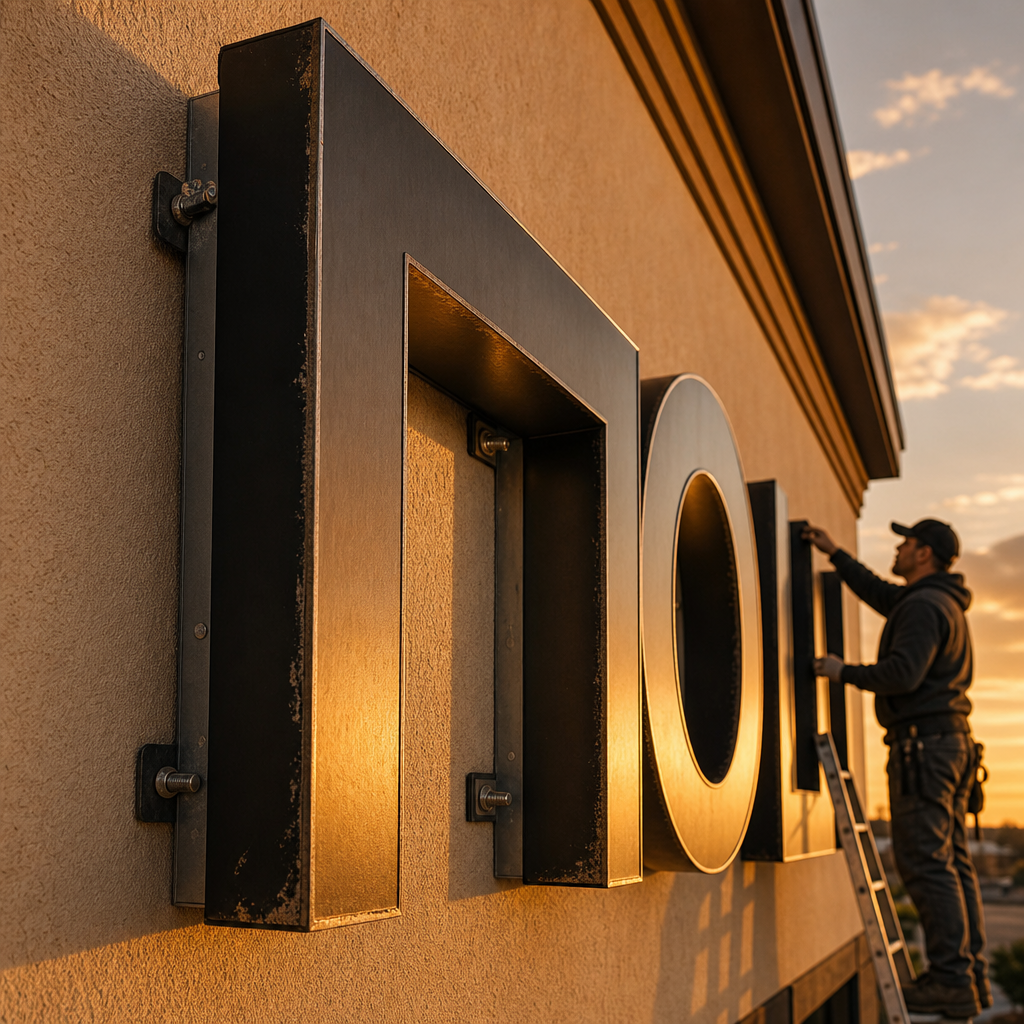
For outdoor signs, common choices are aluminum, weather-grade acrylic, and stainless steel with UV-stable finishes. These get picked because they resist the rust, warping, fading, and moisture that age cheaper substrates.
Aluminum is lightweight and rust-resistant, and it's a standard choice for channel letter returns, monument faces, and pylon cabinets. Weather-rated acrylic shows up on illuminated faces for channel letters and lightboxes, and it resists yellowing better than untreated plastics. Stainless steel is common for flat cut dimensional letters on office and corporate buildings, and it holds up well when properly sealed. Aluminum composite panels (ACM) are flat, durable, and paintable, which suits sign faces and monument panels. For illumination, sealed-housing LED modules rated for outdoor use tend to last longer than older neon or fluorescent options.
Untreated wood, standard MDF, thin plastics, and interior-grade vinyls generally aren't a good bet for anything exposed to sun, rain, or freeze cycles. What looks fine at first can peel, bubble, or fade later.
How do indoor and outdoor sign costs compare?
Outdoor signs usually cost more than indoor signs of similar size, mostly because of weather-rated materials, illumination, structural mounting, and installation. What you actually pay depends on the sign type, size, lighting, and site conditions, so a real number should come from a quote based on your specifics.
Here's where the money tends to go:
| Factor | Indoor signs | Outdoor signs |
|---|---|---|
| Materials | Lighter, interior-grade | Weather-rated, structural |
| Lighting | Often none or ambient | Frequently illuminated |
| Permitting | Less common | More commonly involved |
| Installation | Often a simple wall mount | Structural, sometimes lift-assisted |
| Electrical work | Usually none | Often involved |
| Landlord approval | Less common | More commonly involved |
A backlit channel letter set for a storefront will often cost more than a dimensional acrylic lobby sign of the same letter height. That gap usually reflects the extra engineering and durability the outdoor version needs, not a markup.
For a number that matches your project, send photos, dimensions, and your logo so the pricing reflects your actual site.
Indoor sign ideas for small spaces
In a small interior, it usually works better to lead with one strong statement sign plus quiet wayfinding than to crowd the walls with several signs competing for attention. Scale and finish tend to matter more than raw size.
A few things that work in tight spaces: flat cut metal or acrylic letters behind a reception desk or check-in area, halo-lit dimensional letters on a feature wall for a softer glow, and etched or frosted vinyl on glass partitions when you want privacy and branding at once. Compact wayfinding for restrooms, exits, and office numbers keeps things easy to follow. A single blade-style sign hanging perpendicular to the wall reads well in narrow hallways, and menu boards or product signs earn their space in cafes, salons, and retail counters.
Small spaces reward restraint. One well-made sign in the right spot usually beats several fighting for attention.
Common outdoor weathering problems, and what helps
The usual outdoor complaints are fading colors, cracked acrylic faces, corroded hardware, water getting into lightboxes, and LED failures. Most of these trace back to material choice, sealing, and maintenance.
For fading and yellowing, UV-stable acrylic and quality pigmented vinyls hold color better than budget substitutes. Water intrusion is mostly a sealing issue, so look for proper gasket seals on lightboxes and cabinets and inspect after severe weather. Corroded fasteners are worth heading off with stainless or coated hardware, especially in coastal or humid areas. Warped faces on large lightboxes bow less when you spec thicker acrylic. And for LED failures, commercial-grade outdoor-rated modules with accessible wiring make future service a lot easier.
Planning maintenance from the start usually costs less than replacing a sign early.
Which type of sign gets more attention?
Outdoor signs tend to get more first-look attention because they reach people who haven't decided to visit yet. Indoor signs reach people who are already inside and closer to a decision.
So they're doing two different jobs. The outdoor sign supports discovery and helps turn passersby into walk-ins. The indoor sign supports the in-store experience and helps guide people to products, services, or checkout. For a lot of businesses, the exterior sign has to earn the visit before the interior sign gets its turn, which is why the exterior is often worth prioritizing.
Do outdoor signs need permits?
In many cities and municipalities, exterior signs involve permitting, and the requirements vary a lot by location, sign type, size, illumination, and zoning. Indoor signs less commonly involve permits. Because the rules differ so much, treat this as general context, not a guarantee.
Things that commonly come up: local sign codes covering size, height, and illumination; landlord and property management approval; historic district or overlay zoning restrictions; structural or electrical inspection requirements; and shopping center or plaza signage criteria.
A sign company can help you understand what might apply, but the property owner or business is ultimately responsible for confirming local requirements with the relevant authorities. It's safer not to assume a sign is approvable until you've checked. And a design mockup, including one made with the Signage.com Design Studio, is a visualization aid, not permit, code-compliance, or engineering documentation.

Indoor vs outdoor: how to prioritize
For most physical businesses, neither type does the whole job on its own. Outdoor signs bring people to the door, and indoor signs orient them once they're in. Treating it as an either-or usually leaves one job undone.
A rough way to decide where to start: if few people know you exist, the exterior is often the first place to spend. If people walk in but seem unsure where to go, interior wayfinding and product signage may be the gap. And if your storefront looks dated, refreshing the exterior can be worth it even when the inside is fine.
Signage is on display every day, so it pays to plan it on purpose rather than treat it as an afterthought.
Lighting options for indoor signs
Indoor lighting is usually subtle and built in: halo-lit dimensional letters, edge-lit acrylic panels, or ambient wall-wash lighting that highlights the sign without taking over the room.
Halo-lit letters use LED backlighting to create a glow around dimensional letters, a popular lobby look. Edge-lit acrylic puts LEDs at the edge of a clear panel for a clean, modern effect. Ambient wall wash means aiming track or accent lighting at a non-illuminated sign and letting the finish and shadow do the work. Front-lit lightboxes suit menu boards, product displays, and retail signage where readability matters most.
For a lot of office, medical, and corporate lobbies, halo-lit or non-illuminated dimensional letters with good ambient lighting can look more polished than internally lit signs.
Outdoor sign maintenance to plan for
Outdoor signs benefit from periodic inspection, cleaning, and the occasional component swap to keep looking professional. Building that into the plan protects what you spent.
The basics: clean the faces on a schedule (more often in dusty or coastal areas), inspect the LEDs and replace failed modules before whole sections go dark, and check mounting hardware and seals regularly. Repaint or refinish faded returns and cabinets when they need it, and deal with wind, hail, or vehicle damage promptly.
Costs vary by sign type and access. A single burnt-out LED module is typically a minor service call, while a large channel letter set with several dark letters may need a lift and a technician for a few hours.
What size should a business sign be, indoors vs outside?
Outdoor size is mostly driven by viewing distance and setback from the road. Indoor size is driven more by wall proportion and reading distance. A rule of thumb people cite for exterior signs is about one inch of letter height for every ten feet of viewing distance, though local sign codes and building proportions usually matter more than any single formula.
As a rough guide, outdoor storefront letters often run about 12 to 36 inches or more depending on setback and building size, and monument and pylon signs use larger cabinets to stay legible from moving vehicles. Indoor lobby letters often land between about 3 and 12 inches, sized to the wall, and wayfinding signs stay small, consistent, and easy to scan at walking speed.
The Signage.com Design Studio, an AI-assisted mockup tool, can help you picture how a sign might look at different sizes on your building or wall before you commit to production. It's a visual aid for exploring concepts, not final engineering or fabrication documentation.
Indoor signs for retail stores
In retail interiors, signage usually works best in layers: a hero brand sign, clear category or department signs, and product-level callouts. Each layer has a job.
That tends to look like a dimensional brand sign behind the counter or on a feature wall, category signs above sections (new, sale, seasonal), and shelf-edge or product callouts for featured items. Window signage should support the exterior sign without cluttering it, and wayfinding covers fitting rooms, restrooms, and checkout.
Keeping the font, color, and finish consistent across interior signs helps the space feel intentional instead of pieced together.
Common mistakes when choosing signage
A few missteps come up again and again: choosing on price alone, undersizing the exterior sign, using interior-grade materials outdoors, overlooking lighting, and skipping a mockup before production.
Sizing the outdoor sign too small to save money tends to backfire, since it's then hard to see. Interior-grade substrates outdoors can fade or warp. Skipping lighting on a storefront that needs to work after dark leaves it dark. Overlooking landlord and permit requirements can mean redoing the sign. Approving a design without a mockup often leads to surprises at the finished result. And leaving dated signage up can make the business look tired.
A smoother quote starts before you even ask for one. Photos of your location, your logo files, rough dimensions, and lighting notes make the process faster and more accurate.
Outdoor signs built for harsh weather
In demanding climates, the priorities usually include sealed construction, aluminum or stainless components, thicker weather-rated acrylic, and properly rated commercial LED modules. Channel letters, monument signs, and lightboxes can all be specified for tough conditions.
Coastal areas call for stainless or coated hardware and corrosion-resistant finishes. Hot, sunny climates favor UV-stable acrylic and pigments plus thicker faces to reduce warping. Cold, snowy areas benefit from sealed cabinets to limit moisture and ice damage, along with low-temperature-rated LEDs. High-wind zones need reinforced mounting and a structural review for larger signs.
Telling your sign company about your climate up front helps, since it can change the material spec, not just the price.
Frequently asked questions
Can the same sign be used indoors and outdoors? Sometimes, but often not ideally. An outdoor-rated sign can look overbuilt inside, and an indoor sign generally won't survive outside. It's better to specify the environment up front.
Do outdoor signs always need to be illuminated? No. Illumination helps if your business operates after dark or in low-light areas, or if you want visibility at night. Daytime-only businesses in bright locations can sometimes skip it.
How long do outdoor business signs typically last? It varies a lot by material, climate, and maintenance. Well-built channel letters and monument signs can serve for years with periodic service, while lower-grade substrates may show wear sooner.
Do I need a mockup before ordering? It's a good idea. A mockup takes some of the guesswork out of a visual buying decision and lets you preview scale, color, and placement before fabrication. The Signage.com Design Studio can help you visualize concepts on your building or wall.
What information does a sign company need for an accurate quote? Business type, sign type preference, indoor or outdoor location, approximate size, mounting surface, lighting preferences, your logo file, and photos of the location.
Can I install an outdoor sign myself? For small non-illuminated signs, sometimes. For channel letters, illuminated signs, monument signs, or anything involving electrical or structural work, professional installation is generally recommended and may be required.
How to decide
Indoor or outdoor isn't really the choice to agonize over. What matters more is what your customer sees first and what they need to see once they're inside. The exterior sign earns the visit, and the interior signs carry the experience from there.
A few next steps if you want to move on it:
- Walk your property from the street or parking lot and take photos. Ask whether the exterior sign is doing its job at 100 feet, at 30 feet, and after dark.
- Walk your interior as if it's your first time. Note where you'd feel lost or unsure.
- Gather your logo files, rough dimensions, and site photos.
- Look through outdoor signs and indoor signs to see options that fit your use.
- Request a quote, or use the Design Studio to visualize concepts before you commit to production.
Signage is one of the few brand assets a physical business puts on display every single day. As a Philadelphia-based signage company, Signage.com can help you think through the indoor and outdoor mix, and getting that mix right is worth a little extra thought before you order.
