


Ordering one storefront sign is a purchase. Rolling out signage across a dozen or more locations is a coordination job. You're juggling brand standards, several approval layers, buildings that don't match, and local rules that shift from one town to the next, all while trying to keep every site recognizable as the same company.
This is written for the person running that process. What to lock down centrally, where to leave room for the site, how to put together a request a vendor can actually price, and the questions worth asking before you sign anything. If you're scoping a program right now, the corporate signage collection shows the sign types referenced below.
The short version
Lock the brand centrally, let sites handle their own details. Design, materials, and illumination should be consistent; placement, permits, and landlord rules almost always need local input.
Budget extra time for approvals. Corporate marketing, local management, landlords, and municipal permitting each run on separate clocks, and they rarely line up neatly.
A mockup on a photo of your actual building helps people agree before anything gets built. A detailed request, with logos, site photos, sign types, rough dimensions, and lighting notes, gets you a more useful quote and fewer back-and-forth emails.
Permits and code compliance usually sit with the business, not the vendor. And material choices should follow the environment: climate, maintenance access, and how long you expect the sign to last.
Why consistency is worth the effort
For a lot of customers, the sign is the first thing they judge about a location. In a multi-site brand, that first impression happens over and over, and the gaps between sites are easy to spot. One store has a clean channel letter sign, another has a faded or mismatched one, and it can read as uneven quality even when the business behind both is identical.
A few things you get from consistency:
- Customers recognize the brand faster, whatever city they're in.
- Uniform, well-kept signage reads as attention to detail.
- Standard sign types and materials make reordering and repairs more predictable.
- Physical signs line up with the identity people already see online.
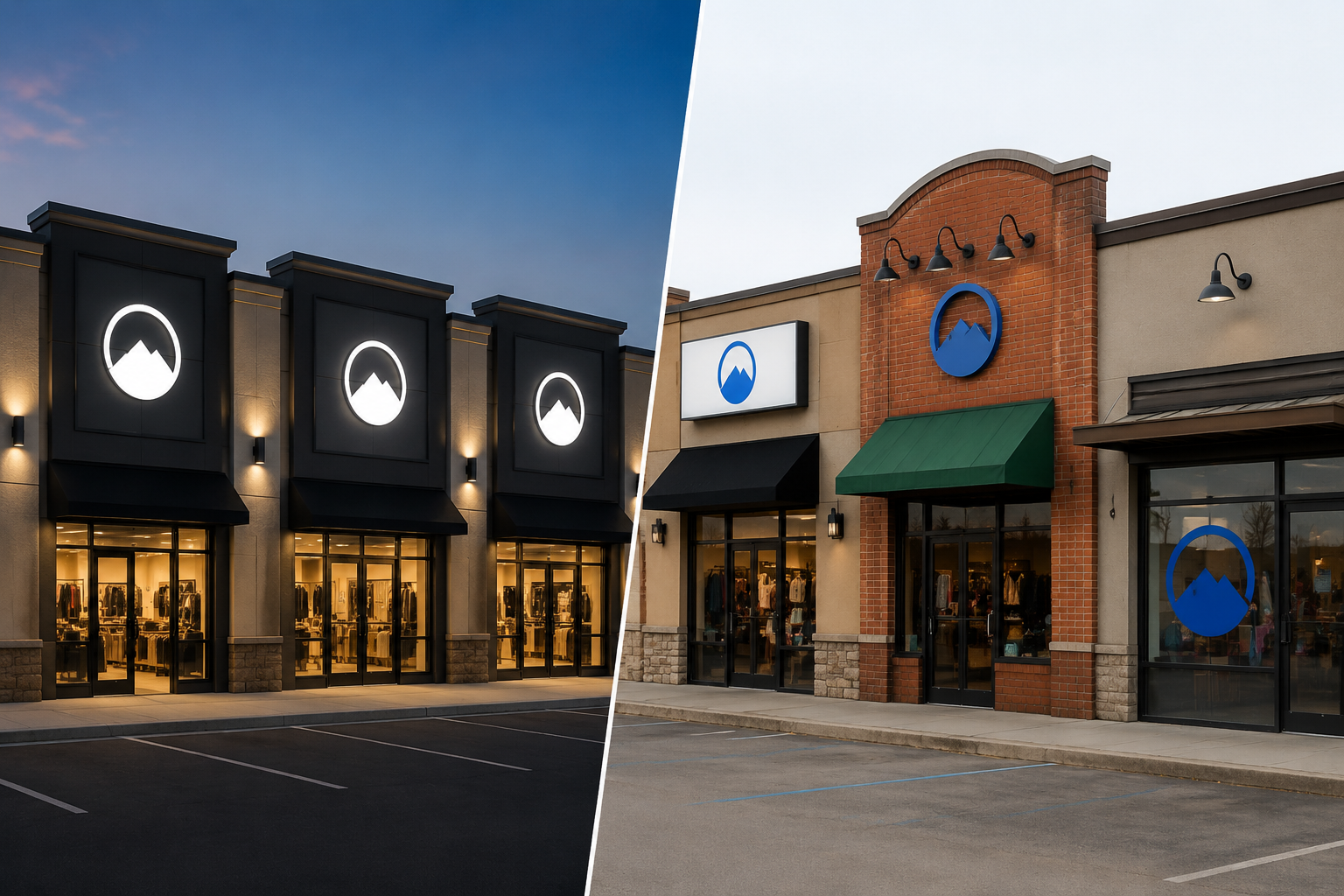
You don't need identical signs everywhere. Some historic districts and landlord rules make that impossible anyway. What you want is a defined system: approved sign types, fonts, colors, illumination styles, and finishes that still hold together when individual sites have to deviate.
What to centralize, what to leave local
One of the earliest calls is where control lives. A common split:
| Decision | Usually centralized | Usually localized |
|---|---|---|
| Logo, colors, fonts | yes | |
| Approved sign types and illumination | yes | |
| Material and finish standards | yes | |
| Overall budget framework | yes | |
| Site-specific placement and size | yes | |
| Landlord / lease requirements | yes | |
| Local permit applications | yes | |
| On-site contact and scheduling | yes |
Central brand standards protect consistency. Local input covers the things only someone standing at the site knows about: a fascia that won't fit the standard letter size, a landlord who won't allow illumination, a municipal cap on sign area.
The approvals you'll actually wait on
Multi-location signage tends to pass through several approval layers, and teams routinely underestimate them. Worth mapping before you request quotes.
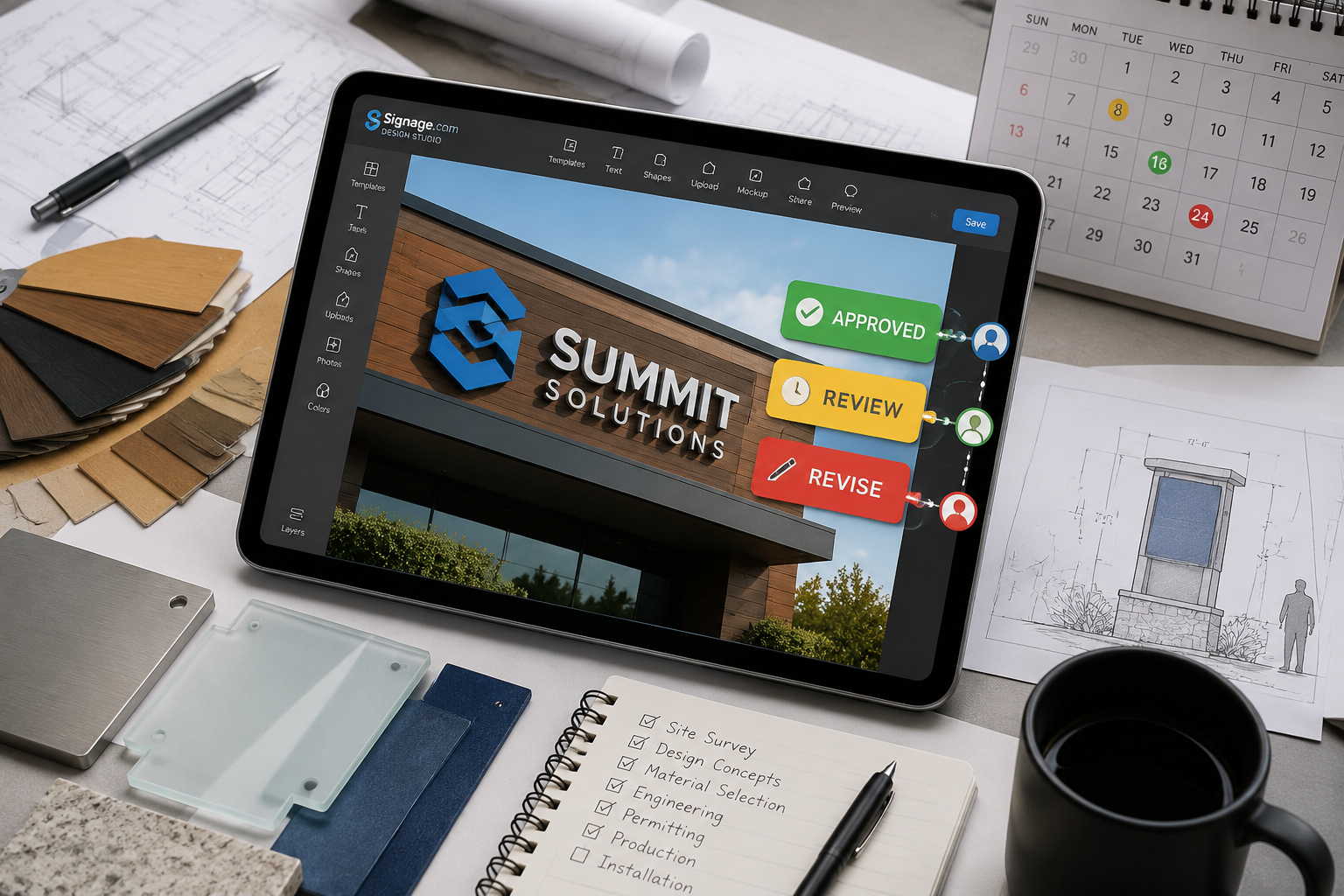
Corporate marketing checks that designs follow brand guidelines. Then someone signs off on the design and mockup before production. Signage.com's Design Studio can drop a sign concept onto a photo of your building, which helps when you're comparing letter style, color, illumination, and scale. Treat that as a way to get people aligned on the look, not as engineering, permit, or code-compliance paperwork.
Local managers or franchisees usually weigh in on placement, size, and mounting for their building. Landlords and property managers come next, since leases often govern sign design, materials, size, illumination, and installation. Confirm those early.
Then there's permitting. Municipal sign ordinances vary a lot. A vendor can offer guidance, but responsibility for permits and compliance generally rests with the business, so early conversations with local authorities save rework later. Finance signs off last to confirm the program fits the budget, per location and overall.
Materials across different environments
Your locations won't share the same climate, sun exposure, or maintenance access, so material choices should account for that while staying consistent within each sign type.
- Acrylic holds vibrant color and detailed faces, and it's common in channel letters and lightbox faces. UV-resistant grades help limit fading.
- Metal, like aluminum or stainless steel, tends to show up in dimensional letters and plaques where you want a durable, permanent look.
- Channel letters usually pair aluminum returns with acrylic faces. Front-lit versions read strongly at night; halo-lit versions give a softer glow.
- Lightbox and cabinet signs generally use aluminum frames with acrylic or polycarbonate faces for nighttime visibility.
A few practical notes. Ease of cleaning and repair matters more once you're maintaining many sites. Cheaper materials can mean replacing signs more often, so it's worth weighing total cost over the life of the sign, not just the upfront number. Keep matching materials and finishes for the same sign type across locations so the program stays cohesive. And some sites, historic districts for example, may call for a more refined variant that still carries your brand.
Putting together a request a vendor can price
Vague requests slow everything down. The more a vendor has up front, the more useful the quote and the fewer rounds of clarification. When you're ready, you can request a free quote with these in hand:
- Your sector, plus high-resolution vector logo files (AI, EPS, SVG) and brand guidelines for colors and fonts.
- Preferred sign types (channel letters, lightbox, monument, blade, dimensional letters), indoor or outdoor, and what each sign is for.
- Addresses for each site, clear exterior and interior photos including wide shots and close-ups of mounting surfaces, and anything unusual about the site.
- Target width and height per sign, plus measurements of the available fascia, wall, or monument space. A rough range beats nothing.
- Lighting: non-illuminated, front-lit, halo-lit or backlit, or other, and whether there's electrical access at the location.
- Any required materials or finishes, and existing signage you need to match.
- Whether you need installation, and any known landlord restrictions or local permit considerations.
- Target dates, keeping in mind that actual timelines depend on scope and approvals.
- A point of contact per location for on-site questions.
Questions to put to a vendor
Picking a partner for a multi-location program is a decision you'll live with for a while. These questions help you read fit.
- Have you run signage programs for multi-site businesses, and how did you handle the coordination?
- How do you keep branding consistent across sites with different architecture and different local rules?
- Can we preview our signs on photos of our actual buildings before production?
- What do you recommend for different climates, and how do you think about durability for outdoor signs?
- How do you help with local permits and code compliance, and what's on us in that process?
- Where are different sign types fabricated, and can you handle larger or more complex work like pylon and monument signs? For reference, Signage.com produces certain higher-value sign types, such as pylon signs, monument signs, and channel letters, in Philadelphia; confirm the specifics for the sign types in your program.
- Do you install directly, coordinate local installers, or ship for local installation? How do you manage delivery to multiple sites?
- Who's our main contact, and how do you handle communication and scheduling across sites?
- What warranty applies, and do you offer maintenance guidance?
- How is pricing structured for multi-site orders, and are there efficiencies in standardizing designs?
Where Design Studio helps
Design Studio is a visual mockup tool, a way to see a sign concept on a photo of your building before you commit. For a multi-location team, that's handy in a few ways.
You can compare options side by side: letter styles, colors, illumination types, scale. You can get everyone looking at one shared visual, from corporate marketing to the local manager, which tends to make approvals go easier. It catches problems early, like a sign that's too small for the fascia or clashes with the building. And a clear visual concept usually makes your quote request more specific.
Just be clear on what a mockup is not. It's a way to align on the look, not final engineering, fabrication specs, permit paperwork, or code-compliance documentation. Those come from the detailed design and permitting steps that follow.
Where this leaves you
For a multi-location team, signage is a program you coordinate, not a stack of one-off orders. The work is in the structure: what to standardize, how the approvals map out, matching materials to each environment, and writing requests a vendor can price against. Get that right and each location, retail, office, medical, or restaurant, reinforces the same brand instead of pulling against it.
When you're ready to scope pricing, gather your assets and start a quote request, or browse the corporate signage collection to see the sign types covered here.
FAQ
Why does brand consistency matter for multi-location signage? Consistent signage helps customers recognize your brand across locations and reads as attention to detail, which supports trust in the business overall.
How do I handle permit requirements in different cities? Sign ordinances vary by municipality, so each location has to be checked on its own. A vendor can offer guidance, but permit applications and compliance typically rest with the business or a local representative.
What should I gather before requesting a quote for multiple locations? Vector logo files and brand guidelines, photos of each site, preferred sign types, rough dimensions, material preferences, lighting needs, and any known landlord or permit restrictions.
How does Design Studio help with multi-location projects? It generates visual mockups of sign concepts on photos of your locations, which helps teams compare options and align before production. It's a visual aid, not engineering or permit documentation.
Are outdoor sign materials the same regardless of climate? No. Material selection should account for sun exposure, moisture, and temperature, since those affect durability and appearance over time.
Should signage decisions be centralized or left to local teams? A common approach is to centralize brand standards, design, materials, illumination, while letting local teams handle site-specific placement, landlord requirements, and permits.
