


A sign is often the first thing a customer sees, and it keeps working after you close for the night. On a Maryland storefront, the right one helps people find you, read your name without squinting, and get a sense of the business before they reach the door. This guide covers the sign types that tend to work for Maryland storefronts, how materials and lighting change the outcome, what to have ready before you ask for a custom sign quote, and a few mistakes that are easy to make.
Key takeaways
- The right sign type depends on your business, your building, how far away people read it from, landlord rules, and local sign codes. There is no single answer that fits everyone.
- Channel letters, lightbox (cabinet) signs, and dimensional letters are common storefront choices when visibility matters.
- Acrylic, metal, and PVC each look and behave differently, which affects weight, durability, and where they work best.
- Lighting keeps a sign readable after dark, which matters across Maryland's mix of downtowns, main streets, and retail corridors.
- Having your logo files, site photos, and rough dimensions ready tends to get you a more useful quote.
- A mockup, such as one built in Signage.com's Design Studio, lets you picture a sign on your own building before anything is made. It is a visualization aid, not an engineering, permit, or code-compliance document.
Why the sign matters for a Maryland storefront
Your sign is a piece of your brand that people see over and over, usually before they know anything else about you. On a busy street in Annapolis or a retail center in Bethesda, a clear, well-kept sign tells a passerby who you are and where the entrance is. A faded or damaged one sends a different message.
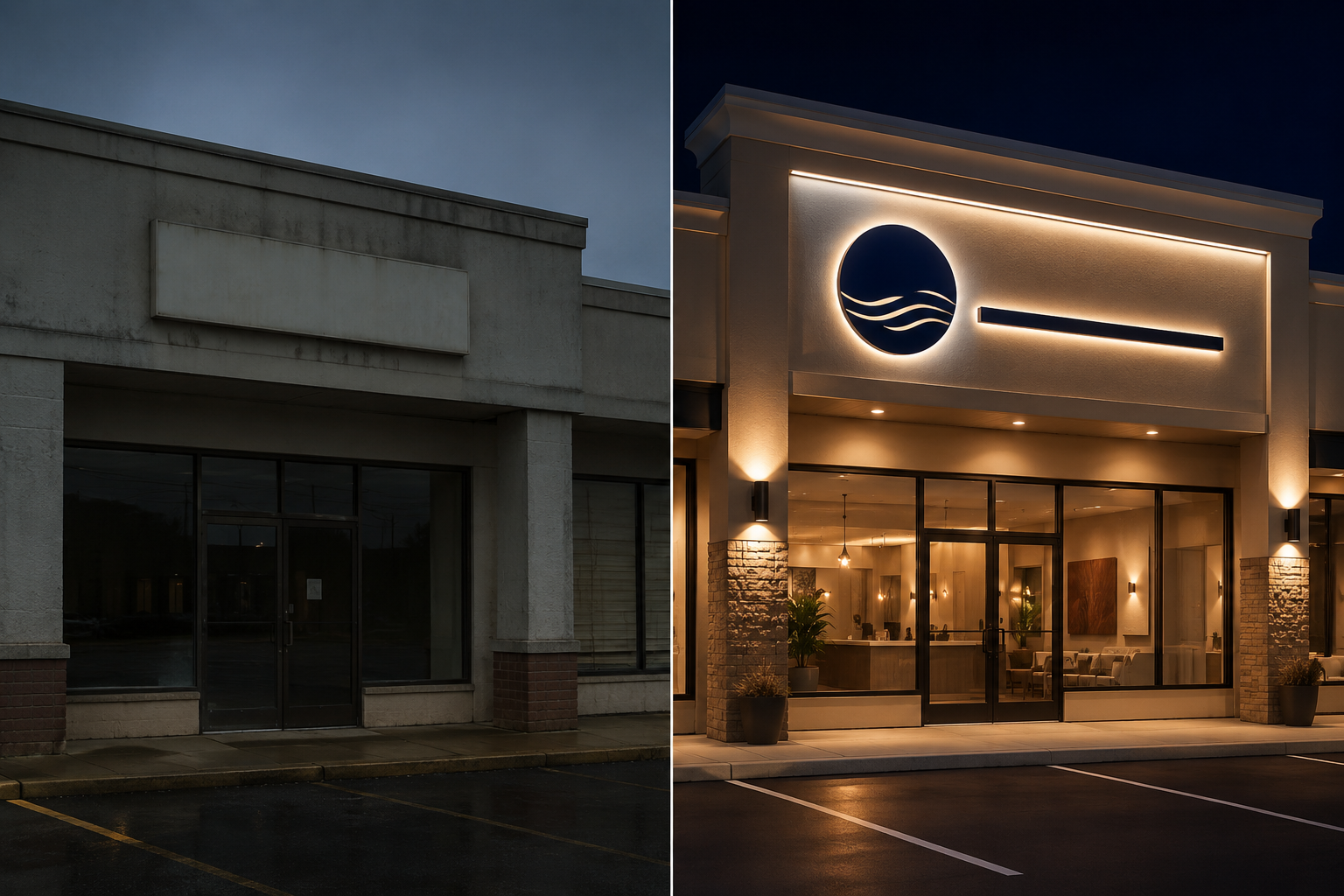
Since it is on display all the time, the sign is quietly doing brand work even when the shop is locked. That is the reason to match it to your building, your surroundings, and the distance people usually read it from. A pedestrian main street and a highway-adjacent retail lot ask for very different signs.
What sign types suit Maryland storefronts?
No single type fits every business. The right pick depends on your building, viewing distance, who you are trying to reach, and any local rules or landlord requirements. Here are the options most storefronts weigh.
| Sign type | What it is | Often chosen for |
|---|---|---|
| Channel letters | Individual dimensional letters or logo elements, usually illuminated | Retail, restaurants, offices wanting a 3D look |
| Lightbox (cabinet) signs | Enclosed cabinet with an internally lit, printed face | Logos or detailed information that need even brightness |
| Dimensional letters | Non-illuminated 3D letters in acrylic, metal, or PVC | Lobby signs and exterior signage with a clean, tactile look |
| Blade signs | Signs projecting out perpendicular from the facade | Pedestrian-heavy main streets and urban blocks |
| Monument signs | Low, freestanding signs near an entrance | Office parks, medical complexes, larger lots |
| Pylon signs | Tall freestanding signs with a large display area | Businesses set back from the road or in shopping centers |
A closer look at channel letters
Channel letters are a common storefront choice because each element is its own structure, which gives a finished, dimensional look. Lighting options include:
- Front-lit, where the face of each letter lights up for direct legibility.
- Halo-lit (backlit), where light comes from behind the letters onto the wall for a softer glow, often used for a more understated feel.
- Combination-lit, which uses both front and halo illumination.
- Raceway-mounted, where the letters attach to a hidden wiring box that mounts with fewer holes in the wall. This helps when a landlord or building limits drilling into the facade.
Lightbox and dimensional signs
A lightbox shows a single illuminated panel and can carry a detailed logo or extra text on the face. Dimensional letters skip lighting altogether for a raised, sculptural effect that reads well in daylight or under existing ambient light, which is why they are a frequent pick for interior lobby signs.
When you narrow it down, think about how far away people read the sign from, the ambient light where you are, and the look of your building. A halo-lit channel letter set might suit a boutique in Federal Hill, while a lightbox could work for a restaurant on a busier commercial stretch.
How materials and lighting change the result
Materials and lighting shape a sign's look, how long it lasts, and how it reads at night. Maryland weather runs from humid summers to cold, snowy winters, so outdoor signs do better with weather-resistant construction, UV-stable finishes, and proper sealing.
Common materials
| Material | Characteristics | Typical use |
|---|---|---|
| Acrylic | Light, available in many colors and finishes, transmits light well | Dimensional letters, lightbox faces, illuminated elements |
| Metal (aluminum, stainless, bronze) | Solid, durable, can be painted, brushed, or polished | Corporate signage and a classic look |
| PVC | Cost-conscious, durable, good for intricate shapes | Dimensional letters where weight matters |
For illuminated signs, LED lighting has become the default because it uses less energy, lasts longer, and comes in a range of colors compared with older neon.
Lighting approaches
- Front-lit, where light shines through the letter faces for a direct, bright message.
- Halo-lit (backlit), where light reflects off the mounting surface for a softer effect.
- Open-face, where the letter face is left open or clear so the modules inside show, giving a bright, industrial look.
- Internal illumination, where LEDs inside a cabinet light a translucent face evenly, as with lightbox signs.
Using the Design Studio to picture your sign
Signage.com's Design Studio is an AI-assisted mockup tool that lets you preview sign concepts on a photo of your own storefront. Signage is a visual purchase, so seeing a rough version in place usually beats imagining it.
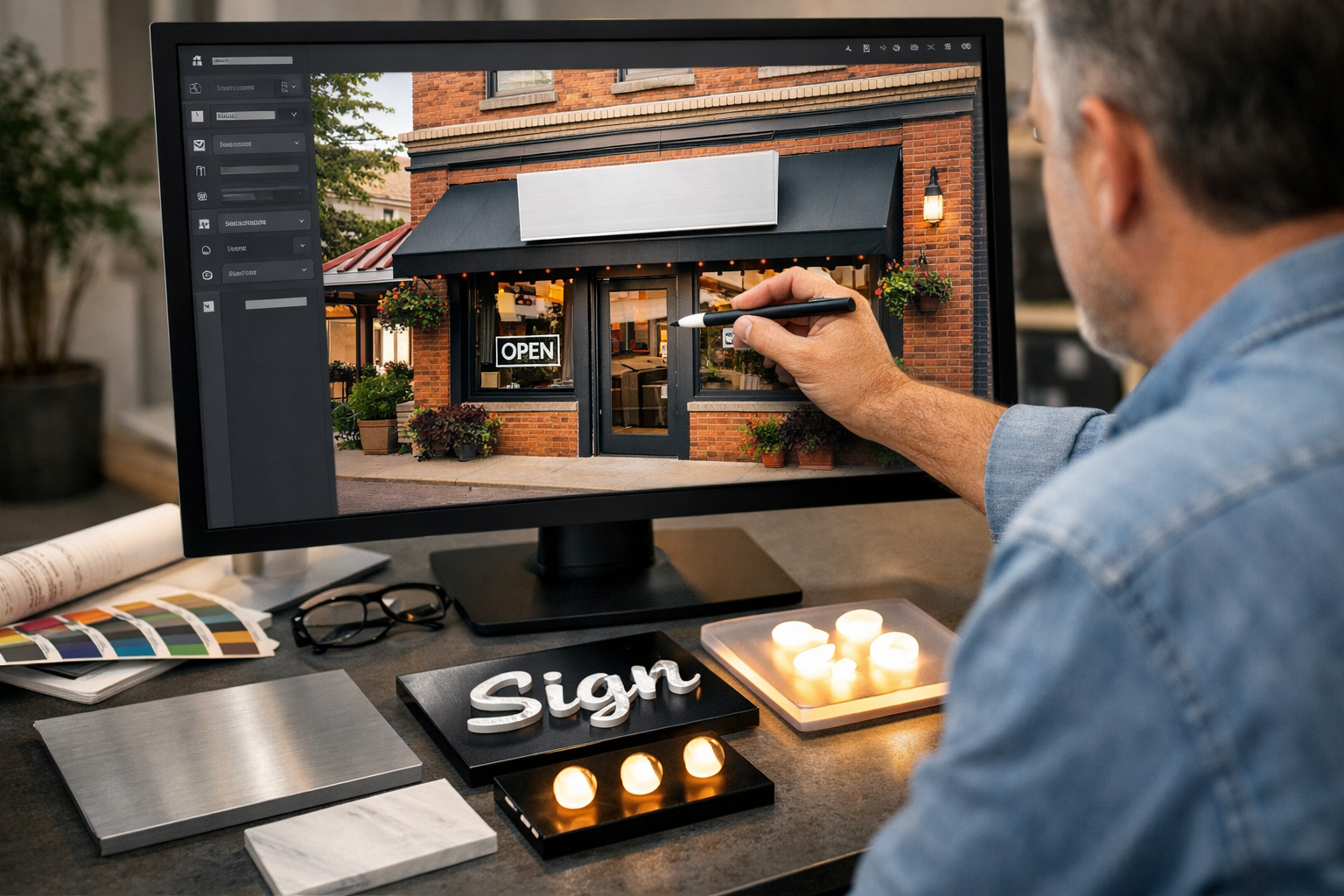
Upload a photo of your location, and the tool lets you see your logo in place at roughly the right scale, compare sign types (say, front-lit channel letters against dimensional metal letters), try out materials and lighting to get a feel for day and night, and check that the concept reads from the distances that matter to you.
Treat the Design Studio as a way to explore a concept, not as final engineering, fabrication, permit, installation, or code-compliance documentation. The point is to walk into the quote conversation with a clearer idea of what you want, which tends to cut down on back-and-forth later. When you are ready, you can request a quote with that concept in hand.
What to have ready for a useful quote
The more you share up front, the more accurate the estimate you get back. When you are ready to request a custom sign quote, try to have these on hand:
- Your business type (retail, restaurant, medical, office, and so on), so the recommendations fit.
- Logo and brand assets, ideally high-resolution vector files (AI, EPS, PDF) plus any brand fonts.
- A preferred sign type if you have one in mind. Even a rough direction helps.
- Whether it is going indoors or outdoors, since that drives materials, lighting, and fabrication.
- Approximate size, whether that is length and height or just the space available on the facade.
- The mounting surface (brick, stucco, metal siding, glass) and any obstacles like windows or pipes.
- Photos of the location from several angles, including a wider shot that shows the surroundings.
- Lighting needs (front-lit, halo-lit, internal, or none), keeping day and night visibility in mind.
- Any material preferences, if you have them.
- A target date. Custom fabrication takes time, and actual lead times vary by project, materials, and current production schedules, so treat any estimate as an estimate rather than a promise.
- Anything you already know about local sign rules or landlord requirements. Permit requirements are set by your local jurisdiction, so it is worth checking with your municipality or county early.
Mistakes that are easy to make
Scale is the common one. A sign that looks fine on a screen can read as small on a large facade, so previewing it on a photo of the actual building helps you judge size before you commit.
Local codes and landlord rules also catch people off guard. Maryland municipalities set their own sign codes, zoning rules, and permit requirements, and landlords add their own. Checking these before you design can save revisions later.
A few others worth watching:
- Weak lighting. A sign that shines by day but disappears at night misses part of its audience. Match the lighting to your hours and the light around you.
- Low-resolution logo files. Raster images (JPG, PNG) can print blurry, while vector artwork (AI, EPS, PDF) reproduces cleanly.
- Choosing on price alone. Cheaper materials can fade or crack sooner, which can mean replacing the sign earlier than you planned. Durable construction usually works out better over time.
- Ignoring placement and readability. Eye level, obstructions, and viewing angle all affect whether people can actually read your sign from the street or sidewalk.
- Skipping a mockup. A visual preview lets you adjust the concept before fabrication instead of after.
FAQ
How long do custom business signs take to produce?
Lead times depend on the sign's complexity, materials, and current production schedules, and illuminated or larger projects generally take longer. Because timing varies from project to project, share your target date when you request a quote and treat any estimate as an estimate rather than a guarantee.
Do I need a permit for a business sign in Maryland?
Many outdoor signs require a permit, and the requirements vary by municipality, county, and sign type. Signage.com does not handle permitting, so check with your local planning office early to understand what applies to your location.
How do I choose between front-lit and halo-lit channel letters?
Front-lit letters put bright, direct light on the message itself, which many businesses choose for nighttime legibility. Halo-lit letters cast a softer glow onto the wall behind them for a more understated look. Seeing both on a mockup of your building can make the choice clearer.
Can Signage.com handle installation in Maryland?
Signage.com focuses on manufacturing and shipping signs ready for professional installation. It does not directly provide installation or guarantee local installer availability. If you need it, we can point you toward coordinating installation locally.
What files do I need to provide for a quote?
Vector files of your logo (AI, EPS, PDF), photos of the building or install area, approximate dimensions, and details on your preferred sign type and lighting all help produce a more accurate estimate.
What materials hold up outdoors in Maryland's weather?
Durable options like aluminum, stainless steel, and quality acrylic are commonly used for outdoor signage that faces temperature swings, humidity, and UV exposure. Proper sealing and UV-stable finishes help with longevity.
Where to start
Choosing a sign comes down to matching the sign type, materials, and lighting to your building, your surroundings, and how people actually see you. Planning the details, pulling together your logo files and site photos, and previewing a concept in the Design Studio all help you decide with more confidence. When you are ready to move forward, you can request a quote with your concept and specifics in hand.
