


For most Connecticut businesses, the sign out front is a working asset. It is often the first thing a customer sees, and it keeps doing its job long after you lock up for the night. Storefront on a historic main street, medical office in a suburban plaza, restaurant on a busy commercial strip: the right sign helps people find you, read your name, and get a sense of whether you run a tight operation.
This guide walks through the practical calls behind a custom sign. Which types fit which locations, what materials hold up in the local weather, what moves the price, and what to have ready before you ask for a quote. The point is to help you go from a rough idea to an accurate custom business signs quote with fewer open questions.
Key takeaways
- A custom sign is a round-the-clock visual for your brand, and it can shape how a customer sizes you up before they walk in.
- Common types for Connecticut businesses include channel letters, lightbox (cabinet) signs, dimensional letters, monument signs, pylon signs, and blade signs. Each fits a different location and goal.
- Material choice matters here, where you get humid summers, cold and snowy winters, and the occasional windstorm.
- Sign type, size, materials, illumination, design complexity, mounting, and site conditions all feed into a quote.
- Zoning rules, permit requirements, and landlord or property-manager restrictions differ by town and by property, so it pays to check them early.
- A visual mockup, like one built in Signage.com's Design Studio, can take some guesswork out of comparing letter styles, colors, and lighting.
Why your sign matters
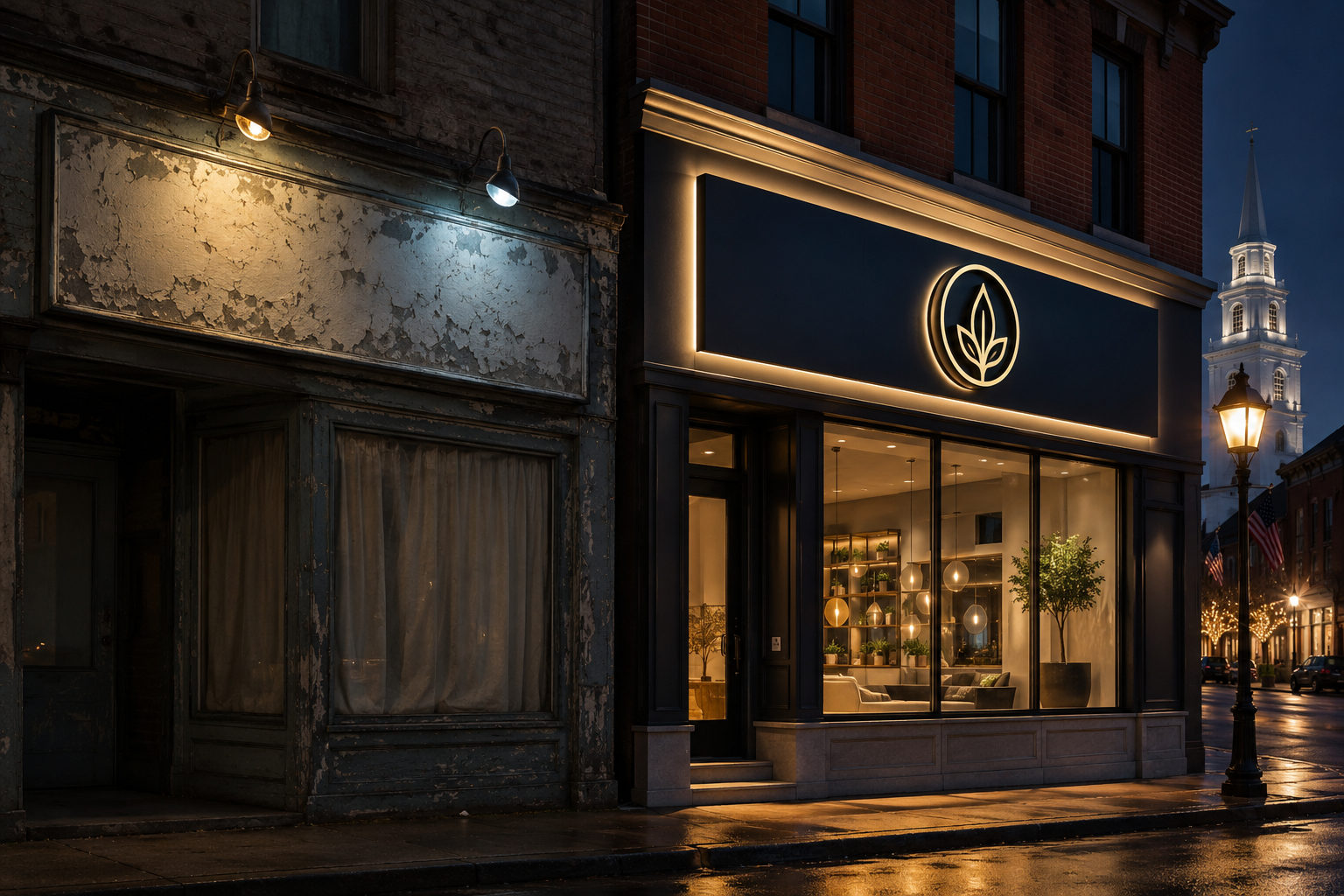
Your sign is usually the first contact a customer has with your business, and it is on display whether you are open or closed. Across Connecticut's downtowns, suburban main streets, and commercial plazas, a clear and well-kept sign helps people find you and suggests you care about the details. A faded, damaged, or hard-to-read sign sends the opposite signal and can leave people wondering whether you are even still in business.
It is easy to think of a sign as decoration. In practice it does a few jobs at once. It shapes a first impression before anyone steps inside. It helps customers navigate to your door in busy areas or confusing layouts. It can echo your online branding so the two reinforce each other. And a crisp, well-lit sign backs up the idea that the business behind it is run the same way.
Choosing a sign type for your location
The right fit depends on your location, your building, your brand, local rules, and how far away you need to be seen. Here is how the common options stack up.
| Sign type | Best suited for | Notes |
|---|---|---|
| Channel letters | Retail storefronts, corporate buildings | Individual 3D letters and logos; can be illuminated for night visibility |
| Lightbox / cabinet signs | Restaurants, service businesses, multi-tenant directories | Illuminated cabinet with a translucent graphic face; steady, even light |
| Dimensional letters | Lobbies, offices, understated exterior branding | 3D letters in acrylic or metal for an architectural look; often not lit |
| Monument signs | Property entrances, medical campuses, shopping centers | Low-profile, ground-mounted; useful when the building sits back from the road |
| Pylon signs | Plazas and businesses near major roadways | Tall, freestanding; readable from a distance |
| Blade signs | Downtown storefronts, pedestrian districts | Project out from the facade; readable both ways along a sidewalk |
Channel letters are one of the more popular storefront choices, so it helps to know the lighting styles. Front-lit letters push light through a translucent face, a common pick for after-dark visibility. Halo-lit (backlit) letters glow from behind against the mounting surface for a softer, more upscale look. Combination-lit blends the two. And non-illuminated letters give you a dimensional presence with no internal lighting, which can work where outside lighting is already strong or the budget is tighter.
When you weigh options, think about who you are trying to reach, the look of your building, how far away people will read it, and how much competing light surrounds you. A medical office might lean toward clean, readable dimensional letters. A retail shop in a crowded row might go with front-lit channel letters to stand out. You can browse configurations for many of these on the custom business signs page.
Materials and durability in Connecticut's climate
Connecticut gives you hot, humid summers, cold winters with snow and ice, and periodic strong winds. That makes material choice as much a practical call as an aesthetic one, since the right materials help a sign hold its look and stay sound over time.
A few materials show up often in exterior signage. Acrylic is used for its clarity and color in dimensional letters, lightbox faces, and lit elements, and it cuts into detailed shapes. Aluminum is light and rust-resistant, common for channel-letter returns, cabinets, and flat-cut letters, and it paints in nearly any color. Stainless steel resists corrosion and reads sleek and modern, so it often lands on higher-end dimensional letters and architectural details. HDPE, a dense plastic, gets used for monument bases and routed signs because it shrugs off moisture and rot.
Worth talking through with your provider:
- Corrosion. Aluminum and stainless steel are usually chosen over untreated steel outdoors, given the rain and snow.
- UV. UV-stable materials and inks help colors resist fading through long summer sun.
- Temperature. Materials should handle wide seasonal swings without warping or cracking.
- Wind. Larger freestanding signs like pylons and monuments lean on solid structure and secure mounting to take storm-driven gusts.
Share your location details so a provider can factor in local conditions. Picking the right materials up front can cut down on maintenance and replacement over the life of the sign.
What affects your quote
Custom sign pricing swings a lot because so many things feed into fabrication and install. A useful quote starts with clear information from you. The big factors:
- Sign type. Individually fabricated, illuminated signs take more work than simple flat-cut letters, and monument and pylon signs carry structural requirements that widen the scope.
- Size. Bigger signs use more material and labor and may need heavier mounting hardware.
- Materials. Premium materials and lighting components (LED modules, wiring, power supplies) add to the base.
- Illumination. Lit signs run higher than unlit versions because of the extra parts.
- Design complexity. Intricate logos, many colors, and detailed type call for more precise fabrication.
- Mounting. Raceway mounting (letters on a rectangular backing) can be simpler than flush-mounting each letter, depending on the building and landlord rules.
- Site conditions. Height, access equipment like a bucket truck, and the mounting surface (brick, stucco, metal panel) all affect labor.
- Permitting. Connecticut towns set their own signage rules and permit fees. A sign company may help with the process, but permit fees are usually separate.
The more detail you bring up front, the closer your first quote will be.
Previewing a sign in the Design Studio
Choosing a sign is mostly a visual decision, and it is hard to picture how a concept will land on your actual building. Signage.com's Design Studio is a mockup tool that lets you preview ideas and compare options with more confidence before you commit. It is a visualization aid, not a stand-in for final engineering, fabrication drawings, permit documents, or code-compliance review, which are handled separately.

A mockup helps you work through the questions that usually stall a decision. How does your logo read as channel letters versus a lightbox sign? What size fits your storefront, and where should it sit for the clearest sightlines? How do different finishes or lighting styles change the look by day and by night? Does the whole thing suit your brand and this particular building?
Seeing a concept dropped onto a photo of your storefront turns an abstract idea into something you can react to, which makes it easier to start the quote conversation with a clearer picture in mind.
What to prepare before requesting a quote
Coming in prepared gets you a more accurate quote and fewer rounds of back-and-forth. A checklist to pull together before you reach out:
- Business type and brand assets - The kind of business you run (retail, restaurant, office, medical, and so on) - Your logo files, ideally in vector format (AI, EPS, or PDF) so they scale cleanly - Any brand guidelines for colors, fonts, or style
- Location and photos - Clear photos of the building or storefront, including close-ups and wider shots - Any known dimensions of the signable area on the facade - The Connecticut address
- Preferred sign type and materials - A sign type in mind if you have one, otherwise a description of the look you want or a budget range - Any material leanings (metal, acrylic, illuminated, and so on)
- Size and placement - Rough dimensions (width x height), or measurements of the mounting area - Where the sign will go (above the entrance, on a pylon, in the lobby)
- Illumination - Whether you want it lit (front-lit, halo-lit, backlit) - Whether electrical access already exists at the location
- Timeline and goals - Your target timeframe, which helps convey urgency - Your main priorities (visibility, an upscale look, staying on budget)
- Landlord or property rules - Any signage restrictions from a landlord or property manager (size limits, material rules, lighting limits) - Any historic-district guidelines that may apply
With these in hand, Signage.com can give you clearer guidance and a closer estimate. When you are ready, you can request a free quote and mockup.
Making sure the sign actually reads
A good sign has to perform, not just look nice. A few things keep it readable and doing its job:
- Scale. It should be big enough to read from real distances, like from passing cars or across a parking lot.
- Font. Clear, legible fonts hold up better far away and in low light. Thin or overly decorative type gets hard to read.
- Contrast. Strong contrast between text and background helps; check how colors read in daylight versus artificial light.
- Placement. Position it clear of trees or poles, at a height drivers and pedestrians can catch.
- Lighting. If you are open after dark, even lighting matters. Patchy or dead lighting makes a place look neglected.
- Focus. A short message, usually your business name and what you offer, reads better than a crowded sign.
People often judge the sign before they judge the business. A clean, well-maintained, professionally designed sign backs up the impression you want customers to have when they arrive.
Frequently asked questions
How long does an outdoor custom sign last in Connecticut? It depends heavily on the materials, the build, and ongoing maintenance. Durable metals and quality acrylics paired with well-sealed LED components are made for outdoor use, but real-world lifespan varies with conditions and upkeep. Your provider can speak to what to expect for the specific materials you choose.
Do I need a permit for a custom business sign in Connecticut? Many outdoor signs do, and the rules for size, type, and placement differ from town to town. Because it is local, confirm your city or town's ordinances before anything gets built. A sign company can often help you sort out what is involved.
Which sign types work for a restaurant that needs night visibility? Front-lit channel letters and LED lightbox signs are both common when steady after-dark lighting is a priority. The right fit comes down to your building, your brand, and local rules.
How long does it take to get a sign made and installed? Timelines vary with design complexity, permitting, material availability, and scheduling. Design, approvals, fabrication, and install all factor in, so talk through a realistic window with your provider for your specific project.
Can custom signs hold up to Connecticut winters? Signs built with appropriate outdoor materials and sealed components are made for cold, snow, and ice. Choosing materials suited to the climate, and talking through conditions with your provider, helps support long-term durability.
What should I have ready for a quote? Your logo files, photos of the building, rough dimensions, a preferred sign type, some material ideas, and any local rules or landlord restrictions you know about. More detail up front usually means a closer estimate.
When you are ready to move, pull your details together and look at the options on the custom business signs page, or request a free quote and mockup to get the conversation going.
