


Quick answer
A custom business sign is built around your brand, your building, and the way people actually approach it. The main categories are channel letters, lightbox cabinets, monument and pylon signs, blade signs, dimensional or flat cut letters, and interior lobby signs. What you pick comes down to where the sign lives (indoor or outdoor), how far away people read it from, lighting conditions, landlord and lease rules, and budget.
You can gather most of what you need in an afternoon: photos of the location, a vector logo file, rough dimensions, and a visual mockup placed on your actual building instead of a guess. Once you have those, a quote request turns into a real conversation rather than a rough estimate.
Key takeaways
- Signage is one of the first things a customer sees, so it shapes an impression before anyone walks in.
- The common custom categories are channel letters, lightbox cabinets, monument and pylon signs, blade signs, dimensional or flat cut letters, and interior signs.
- Price is driven by size, material, illumination, mounting, and installation conditions, not a flat price sheet.
- Outdoor signs need weather-rated materials, high contrast, and stroke widths thick enough to read at distance.
- For a permanent storefront, office, or restaurant, custom is usually a better fit than a generic pre-made sign.
- Permits, landlord approvals, and electrical access are worth confirming before fabrication starts.
- A visual mockup (for example, one built in Signage.com's Design Studio) reduces guesswork before you commit to production.
- Quote-ready details like photos, logo files, dimensions, and timeline goals make pricing conversations more accurate.
What are the different types of custom business signs?
Custom signs fall into a handful of core categories, and most buyers only need two or three of them. The starting question is simple: where will the sign be seen from, and how much visibility does it need to earn?
- Channel letter signs. Individual dimensional letters, usually illuminated. Front-lit pushes light through the face. Halo-lit (reverse) glows softly behind each letter for a more understated look. Combination-lit uses both. Common for storefronts, restaurants, and offices.
- Lightbox (LED cabinet) signs. A framed cabinet with an illuminated face. Works well in high-traffic corridors, strip centers, and after-hours visibility on a tight fascia.
- Monument signs. Ground-level structures at driveways or property entrances. Common for corporate campuses, medical and dental offices, and multi-tenant buildings.
- Pylon and pole signs. Tall freestanding signs built for highway or parking-lot sightlines.
- Blade signs. Projecting signs mounted perpendicular to a wall. A fit for walkable retail districts and cafes.
- Dimensional and flat cut letters. Non-illuminated letters cut from metal or acrylic. Clean and professional, popular in lobbies and modern office exteriors.
- Interior signs. Lobby signs, wall and wayfinding signs, ADA signage, and interior brand walls.
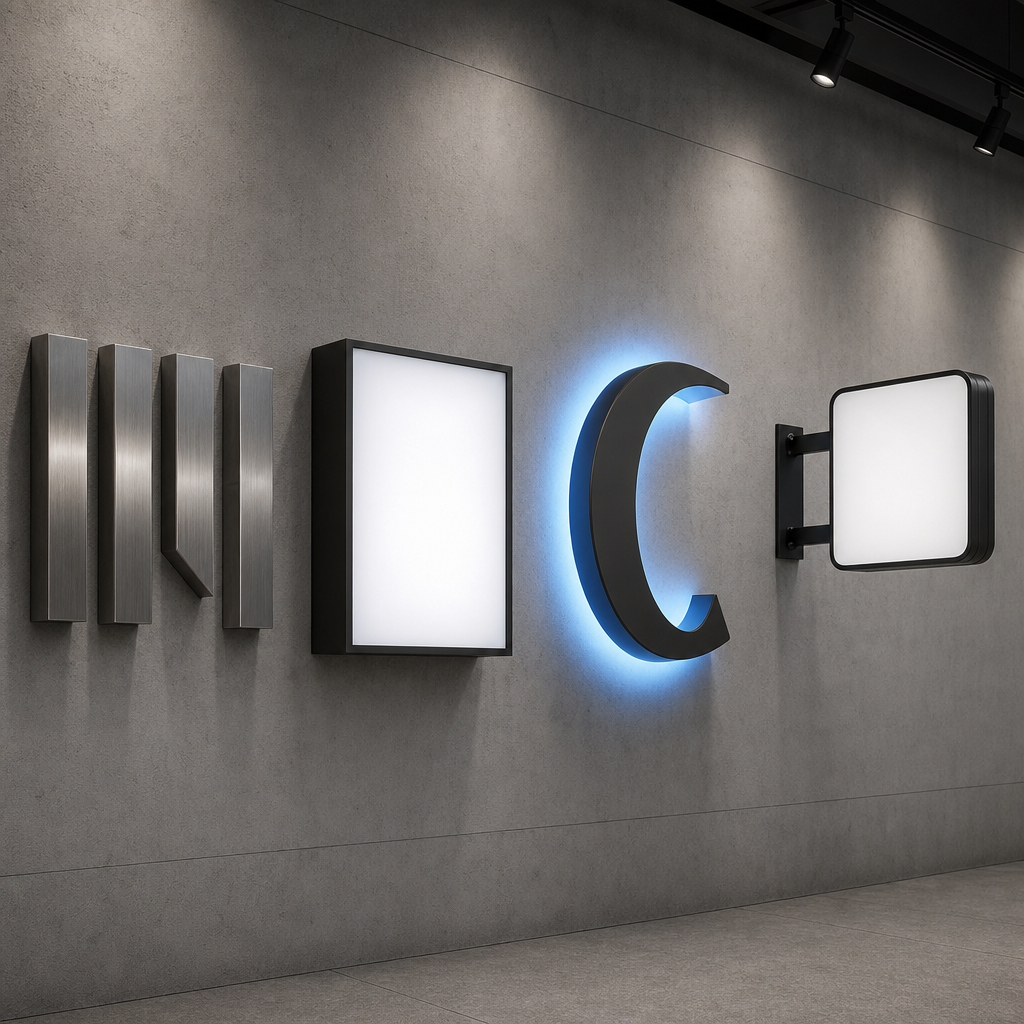
A quick way to narrow it down:
| If you need... | Consider... |
|---|---|
| A premium, illuminated storefront presence | Channel letters (front-, halo-, or combination-lit) |
| Bold night visibility on a tight fascia | A lightbox cabinet |
| Visibility when your building sits back from the road | A monument or pylon sign |
| Presence in a walkable district | A blade sign |
| A clean, non-illuminated look | Dimensional or flat cut letters |
How much does a custom business sign cost?
Pricing varies because every sign is built around a specific size, material, illumination style, and mounting method. A small non-illuminated letter set for a lobby sits at a very different point than an illuminated channel letter storefront, or a monument sign that needs foundation work. There is no honest flat rate, but the cost drivers are predictable.
| Cost factor | Why it matters |
|---|---|
| Size and letter height | Larger signs use more material and often need heavier mounting. |
| Material | Aluminum, acrylic, stainless, and composite panels price differently. |
| Illumination | Front-lit, halo-lit, and combination-lit each use different components. |
| Mounting | Direct-mount, raceway, or backer panel changes both fabrication and install. |
| Installation and permits | Height, electrical access, and municipal rules affect labor and timeline. |
The most reliable way to get real numbers is a quote request with photos and dimensions, rather than an estimate based on assumptions.
What are the best materials for outdoor business signs?
Outdoor signs need materials that hold up to sun, rain, wind, and temperature swings without fading, warping, or corroding. Common outdoor-rated choices include aluminum, stainless steel, weather-rated acrylic, and high-density urethane. Vinyl overlays get used for graphics, but they should be UV-rated.
- Aluminum. Lightweight and corrosion-resistant. Standard for channel letter returns and monument panels.
- Acrylic. Diffuses LED light evenly, which is why it shows up so often on illuminated faces.
- Stainless steel. A durable, refined finish for flat cut letters and corporate exteriors.
- Aluminum composite panels. Rigid and flat. Common for lightbox faces and monument skins.
You can usually spot an under-specified outdoor sign as it ages: faded color, yellowed acrylic, rust bleed, or peeling vinyl. Matching the material to the environment from the start avoids most of that. If you are comparing exterior options, the outdoor signs collection is a good place to see the range.
How long do custom business signs last?
A well-built custom sign can last many years with routine care, though exact lifespan depends on materials, illumination, exposure, and maintenance. Metal structures typically outlast plastic components, and LED modules generally outlast older fluorescent tubes, which is why LED is the current standard for illuminated signs.
Two things tend to cut a sign's usable life short faster than anything else: using indoor-rated materials outdoors, and skipping maintenance entirely. Cleaning the face, checking mounting hardware, and replacing failed LEDs early keeps a sign looking active.
Custom signs vs. pre-made signs
For a permanent storefront, office, restaurant, or medical practice, custom is usually the better fit. Pre-made or generic signs rarely match brand colors, letter proportions, or building scale, and they can read as a placeholder even when they are meant to be permanent.
Custom tends to make sense when the sign represents your brand at a fixed location, is visible from the street, or needs illumination. Pre-made can be fine when the sign is temporary, internal, or purely functional, like a small directional sign.
What size sign do I need for my storefront?
Sign size depends on viewing distance, fascia dimensions, and local sign codes. One widely used readability rule of thumb: for every 10 feet of viewing distance, add roughly 1 inch of letter height. By that guideline, a sign read from about 100 feet generally wants letters in the range of 10 inches tall. Treat it as a starting point, not a hard rule. Codes and lease limits still apply.
A few other things worth weighing:
- Fascia proportion. Leave breathing room on all sides. Signs that touch the edges look cramped.
- Stroke width. Thin strokes disappear at distance. Keeping stroke width near 15% of letter height helps outdoor legibility.
- Contrast. Dark-on-light or light-on-dark reads far better than similar tones.
- Landlord and lease rules. Many commercial leases cap sign area, letter height, or illumination hours.
A visual mockup placed on a photo of your actual building removes most of the guesswork here. That is what Signage.com's Design Studio is for, as a mockup aid before anything is engineered or fabricated.
How to choose a custom sign company
Not every sign company handles every sign type equally. Some focus on vinyl and decals. Others specialize in fabricated channel letters, monument signs, and multi-location programs. The more useful question is not "who is cheapest," but "who has done this type of sign, at this size, for this kind of business?"
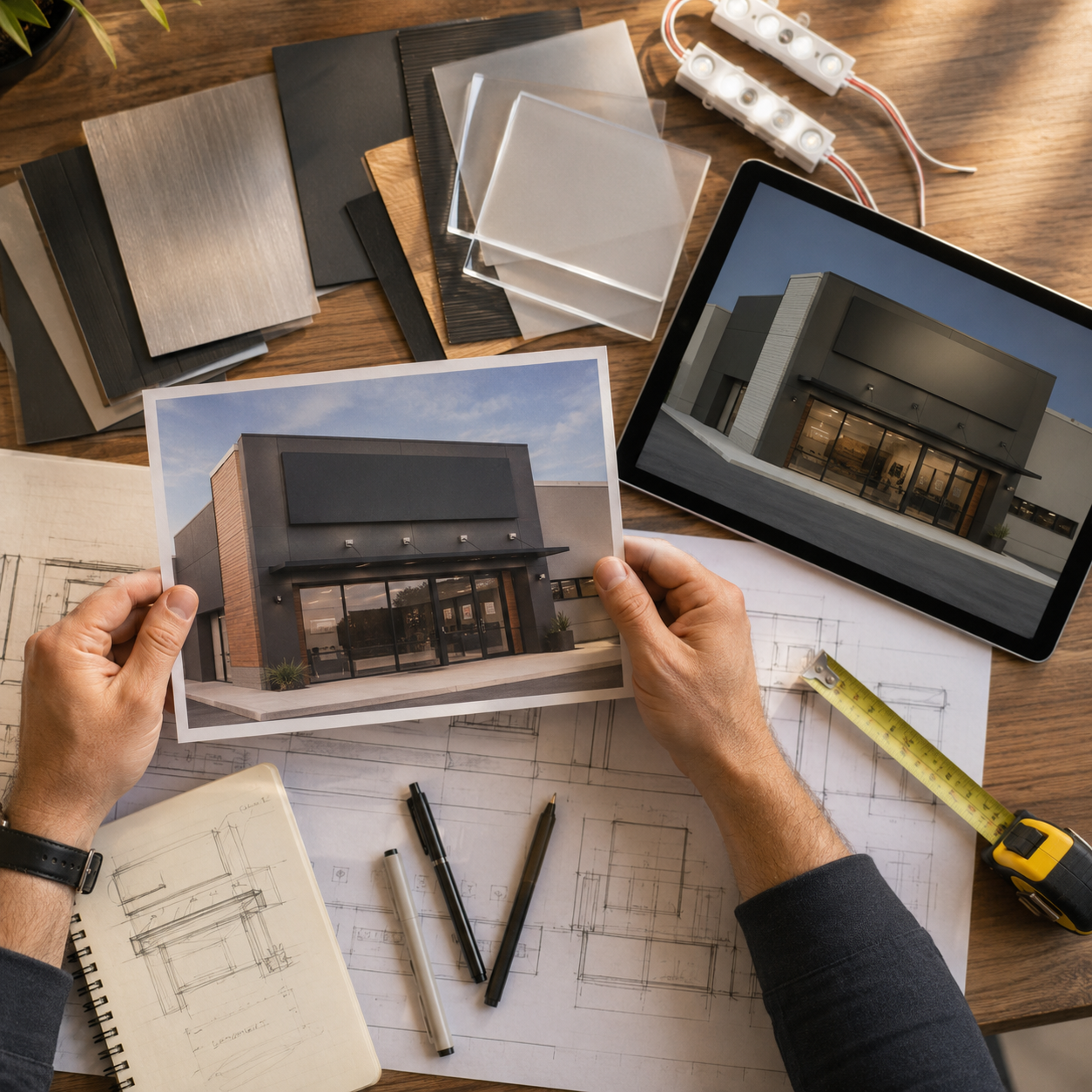
What to look for:
- Experience with your specific sign type (channel letters, monument, lightbox, and so on).
- A clear quote process that asks for photos, dimensions, and logo files.
- Visual mockup or preview support before fabrication.
- Straight answers about materials, illumination, and mounting.
- A willingness to talk through permits and landlord considerations without overpromising.
- A team with real signage experience, not just an order desk.
Signage.com has a Philadelphia location that supports fabrication and assembly for certain higher-value projects, such as channel letters, monument signs, and pylon signs. Customer visits are by appointment.
Common mistakes when ordering custom signs
Most costly signage mistakes happen before fabrication starts, not during it.
- Ordering without a mockup. Guessing how a sign will sit on the building is how buyers end up with signs that feel too small, too busy, or off-brand.
- Ignoring landlord and permit rules. Fabricating a sign that is not allowed on the fascia is an expensive lesson.
- Choosing decorative fonts for distance viewing. Script and thin serif faces often disappear from the sidewalk.
- Skipping lighting decisions. A sign that vanishes after dark is not working during your evening hours.
- Under-specifying materials. Indoor-rated acrylic used outdoors leads to yellowing and warping.
- Sending a low-resolution logo. Vector files matter for clean fabrication.
How long does it take to get a custom sign made?
Timelines vary based on sign type, size, materials, illumination, permit needs, and installation scheduling. A simple set of interior letters moves differently than a permitted illuminated storefront or a monument sign that needs foundation work. Realistic phases to plan for:
- Design and mockup review. Days to a couple of weeks, depending on revisions.
- Fabrication. Depends on complexity and material availability.
- Permits. Controlled by the municipality, not the sign company, and can add meaningful time.
- Installation. Depends on scheduling, height, and electrical access.
Signage.com does not promise exact production or install dates, because approvals and site conditions vary. Sharing your timeline goals early keeps the quote conversation grounded.
Can I use custom signs indoors and outdoors?
Some sign types work in both settings, but materials and finishes usually need to change. Flat cut metal letters can live indoors or outdoors when the metal and finish are weather-rated. Acrylic lobby signs built for indoor use should not be moved outside. Outdoor illumination systems are sealed and weather-rated; indoor systems typically are not.
If you want a consistent look across interior and exterior signs, it is easier to design the family together from the start than to match them later.
Do I need permits for a custom sign?
Most exterior business signs require some form of permit, and the rules vary by city, county, and sometimes by shopping center. Wall, monument, pylon, and illuminated signs commonly need permits. Interior signs often do not. Landlords may also have their own sign criteria on top of municipal rules.
A responsible sign company will raise permit questions early, but final authority sits with local government, and no sign company can guarantee approval.
Options for small businesses on a budget
You do not need a large budget for a professional storefront. The trick is putting your money into one sign that does the most visible work well, rather than spreading it thin across several weak ones.
- Non-illuminated dimensional letters on a clean fascia for a modern, lower-cost look.
- A single well-built channel letter set instead of an oversized lightbox.
- A blade sign for walkable districts where foot traffic matters more than driving sightlines.
- Interior lobby signs paired with simple exterior graphics for offices that see most visitors by appointment.
LED vs. vinyl business signs
LED signs use light-emitting diodes to illuminate letters or cabinets, giving day-and-night visibility. Vinyl signs use adhesive graphics applied to a substrate or window, with no illumination on their own. LED is standard for storefronts and cabinets that need to be seen after dark. Vinyl works well for window graphics, hours of operation, and secondary messaging. Modern illuminated signs almost always use LED because it runs cooler, lasts longer, and spreads light more cleanly than older lighting.
How to maintain and clean custom signs
Routine maintenance keeps a sign looking active and extends its usable life.
- Clean faces with mild soap, water, and a soft cloth. Avoid abrasive pads.
- Check illumination at night monthly and replace failed LED modules promptly.
- Inspect mounting hardware and seals annually, especially after storms.
- Refresh finishes on painted metal before rust or fade sets in.
Frequently asked questions
What information does a sign company need for a useful quote? Photos of the location, a vector logo file, rough dimensions, indoor or outdoor placement, mounting-surface details, illumination preference, and timeline goals. The more specific the input, the more useful the quote.
Do I need a mockup before ordering? It is strongly recommended. A mockup lets you see scale, color, and placement on your actual building before committing to fabrication. Signage.com's Design Studio is a visual mockup aid built for exactly that step. It helps you picture the sign, not replace engineering, permitting, or fabrication drawings.
Can Signage.com handle multi-location signage? Multi-location and national sign programs are a fit when brand consistency across sites matters. Share the site list and brand standards at the quote stage.
Are custom signs worth it for a small storefront? Often, yes. A single well-designed custom sign tends to do more for a small storefront than several generic ones.
What if my landlord has strict sign rules? Share the landlord criteria at the quote stage. Design decisions can usually be adapted to stay within fascia limits, letter-height caps, or illumination restrictions.
Does Signage.com handle installation? Installation availability depends on the project and location. It is best to discuss install needs during the quote conversation rather than assume.
Next steps
Signage is one of the few brand assets a physical business runs every single day. Getting it right is less about picking the fanciest sign and more about matching type, size, materials, and illumination to your building, your buyer, and your budget.
A practical next step: gather a few photos of your storefront, your logo as a vector file, and rough dimensions of the space where the sign will go. From there, a free quote request or a Design Studio mockup turns a vague idea into something you can actually evaluate before anything gets fabricated.
